

Why do ChatGPT, Claude, Gemini and Grok all use the familiar SaaS packaging with usage limits for their direct to consumer offering?
Because of the Goldilocks effect. With three paid tiers, buyers most often choose the middle to avoid extremes. That hasn’t changed with AI.
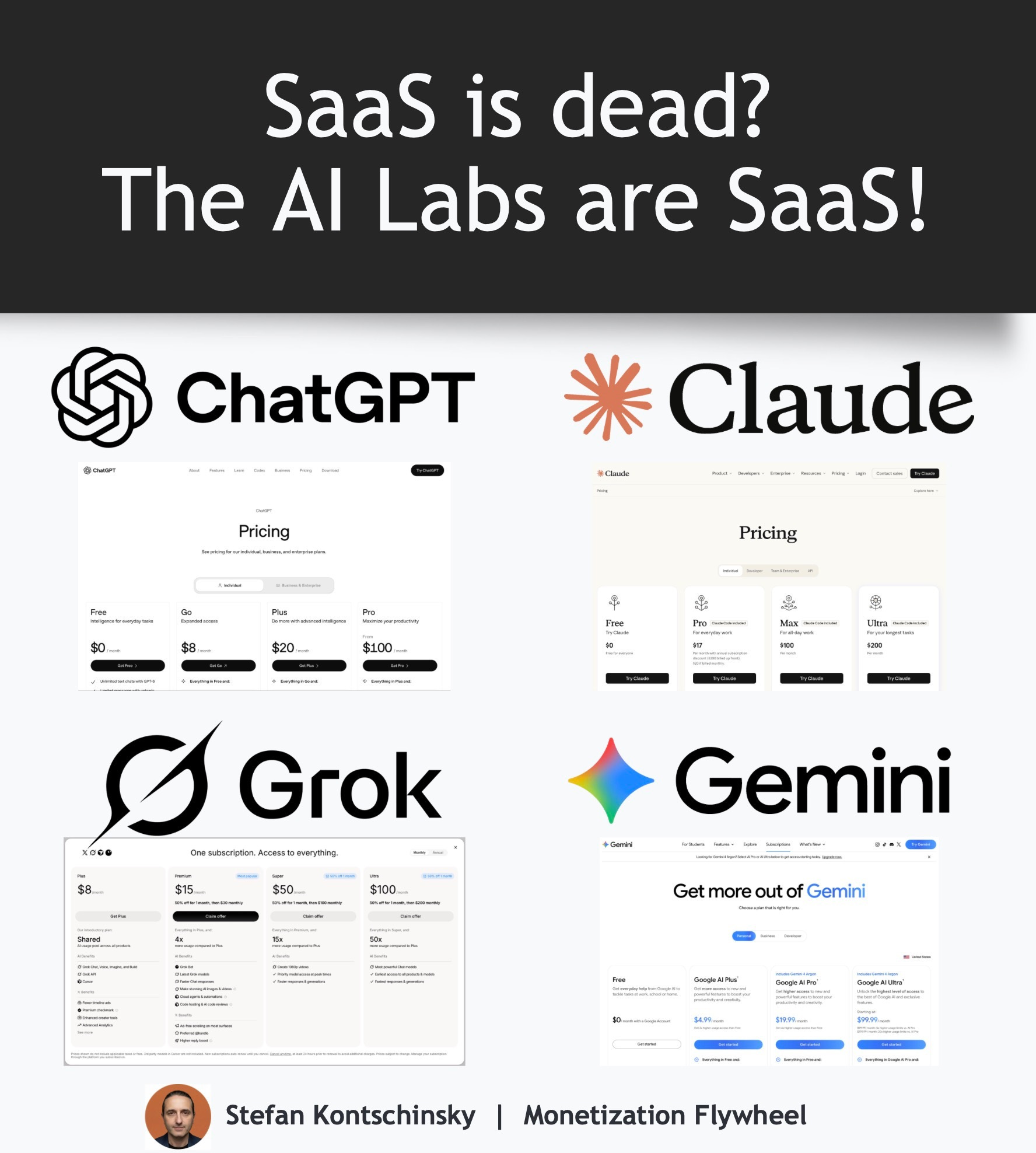
AI has the familiar SaaS subscription ladder
Anthropic shared in their S-1 filing that subscriptions make up 20% of total revenue. For OpenAI, Reuters reported subscriptions contribute even ~70% of their revenue.
Four major frontier AI labs now offer the typical 3 to 4 paid SaaS subscription tiers:
ChatGPT’s 3 paid tiers: Go ($8), Plus ($20), Pro ($100 / $200 / $500)
Claude’s 3 paid tiers: Pro ($20), Max ($100), Ultra ($200)
Gemini’s 3 paid tiers: Plus ($4.99), Pro ($19.99), Ultra ($99.99 / $199.99)
Grok’s has 4: Plus ($8), Premium ($30), Super ($100) , Ultra ($200)
First, they started with the $20/$30 plan.
Then they added on the premium tier: OpenAI added Pro in December 2024. Anthropic added Max in April 2025, Google introduced Ultra in May 2025, and Grok added Heavy in July 2025.
Lastly, they bolted on the cheaper entry level tier: OpenAI tested Go in 2025 in India, then rolled it out globally in January 2026. Google launched Plus first in Indonesia in 2025, then rolled it out in January 2026. Grok added Plus in October 2026.
That positioned the earlier plans as the compromise that most average buyers pick.
The research on the Goldilocks effect
Simonson and Tversky showed in 1992 that customers tend to avoid extremes and prefer the middle option. They presented two groups with similar purchase choices:
Group 1 had two choices: a camera for $169.99, and one for $239.99
Group 2 had the same two choices plus a third one for $469.99
In group 1, both cameras were picked 50% of the time. In group 2, only 22% chose the cheapest camera, 21% chose the most expensive. The $239.99 camera was chosen by 57%. Simply adding a premium option increased demand for the middle camera by +7 percentage points. Its relative share vs. the cheaper option increased by +22 percentage points.
Other researchers have validated that demand uplift:
Kivetz, Netzer & Srinivasan (2004) found relative share shifting +24 percentage points in three-option experiments, and +17 percentage points with five options.
Neumann, Böckenholt & Sinha (2016) conducted a meta-analysis of 142 experiments and found “significant positive effect” for the mid option.
Researchers have also tested the limits of the Goldilocks effect. Adding more options seems to reduce the Goldilocks compromise effect:
Sharif, Webb & Bhatia (2025) covered six studies and found adding a third option increased the share of the middle tier by +10.8 percentage points. With four options that decreased to only +2.8 percentage points.
Stanley & Wedell (2024) found that the compromise effect was +15 percentage points with 3 options. With 9 options it was no longer statistically significant.
The three lessons for you as a AI pricing leader
Knowing the Goldilocks effect, keep these three things top of mind when pricing AI:
1. Ensure your middle tier optimizes margin, balancing capability and price
Start with segmenting your customers, for example by usage: occasional use, daily work vs. intensive workloads. Identify the capabilities and usage of your core ICP. Define your middle tier around that and optimize your margin. Based on the Goldilocks effect, this is what you will sell most of, so make sure you are happy selling a lot of this to fuel profitable growth.
2. Your premium tier needs to add something easy to understand
Prospects need to easily understand what extra spend buys them. Your entry tier can limit access to frontier models or be supported by ads, such as OpenAI’s Go. Your premium tier needs something that solves a real problem customers are willing to pay extra for, like OpenAI always-on Dots agents.
3. Test and iterate on your plan tiers
Optimizing packaging and pricing is a journey. Anthropic just renamed their “Max (20x)” tier to “Ultra” to make “Max” their middle tier at $100. Measure contribution margin as you experiment. Learn, iterate, and don’t forget about the Goldilocks effect.


Nice recap, long live SaaS!
This holds for small service firms too. A top package that few people buy still does a job: it makes the middle one look reasonable. Many owners remove it because it "doesn't sell," and then the middle sells less too.