

Many in the pricing community agree that per-seat pricing is weakening in AI. Seats no longer scale cleanly with value creation, while usage often drives cost-to-serve without increasing revenue. That is why pricing teams are debating whether to charge per credit, per API call, per workflow, per outcome, or something else entirely.
In SaaS, companies defaulted to per user pricing because seats were easy to explain, tracked value well enough, and variable costs were manageable. AI changed that. Costs are real, usage is often concentrated in power users, and outcomes can be attractive but hard to attribute.
In AI, the pricing metric often matters at least as much as the price point. Pricing teams spend a lot of time thinking through which pricing metric is ideal, so I pulled together what the experts say, and synthesized them into one practical framework.
What the experts say about a good pricing metric
A lot of smart people in pricing have already described what makes a good pricing metric. They use different language, but they are largely pointing at the same underlying truth: a pricing metric has to work for the customer and for the company at the same time.
Here is what some great pricing leaders said makes an ideal pricing metric:
Nagle & Mueller’s classic “The Strategy and Tactics of Pricing” has 5 criteria:
- Tracks with Difference in Value Across Segments
- Tracks with Differences in Cost-to-Serve
- Is Easy to Measure and Enforce
- Facilitates Favorable Positioning Versus Competition
- Aligns with How Buyers Experience Value in Use
Kyle Poyar gave a SaaS monetization list of criteria in 2023 recommending metrics should be Value-based, Flexible, Scalable, Predictable, Feasible.
Simon-Kucher focuses on value and fairness: “The most effective price metrics are the ones that are aligned with the value customers derive from the offering. This means that the price scales alongside customers’ success or their usage of the software. How predictable and measurable these metrics are will depend on the industry your company operates in. At a minimum, however, price metrics should be accepted and considered fair by customers.”
Ed Arnold says that “Good pricing strategies align the product’s price metric with either the customer’s usage or value metric.“
Amy Konary has 5 criteria with a heavy focus on the customer view:
simplicity, predictability, transparency, control, and behavior.
Mark Stiving names these 5 criteria for a pricing metric: Fairness & trust, Comprehension, Predictability, Growth & expansion, and Profitability.
Each of these focus on something important. Nagle & Mueller and Kyle Poyar lean more toward value capture and feasibility. Simon-Kucher, Ed Arnold, and Amy Konary put more emphasis on customer value alignment, predictability, and acceptance. Mark Stiving comes closest to balancing both sides by making the commercial consequences explicit. What I wanted, though, was one practical framework that separates and brings together the needs of both the customer and the provider.
Bringing the expert frameworks into one
These experts focus on different dimensions of the same underlying challenge. The core pattern across all of these expert frameworks is that a good pricing metric has to do two jobs at once. It must work for the customer, and it must work for the provider.
My synthesis is to collapse them into six practical criteria:
For the buyer: be intuitive, controllable and predictable
For the seller: be attributable, scalable and feasible
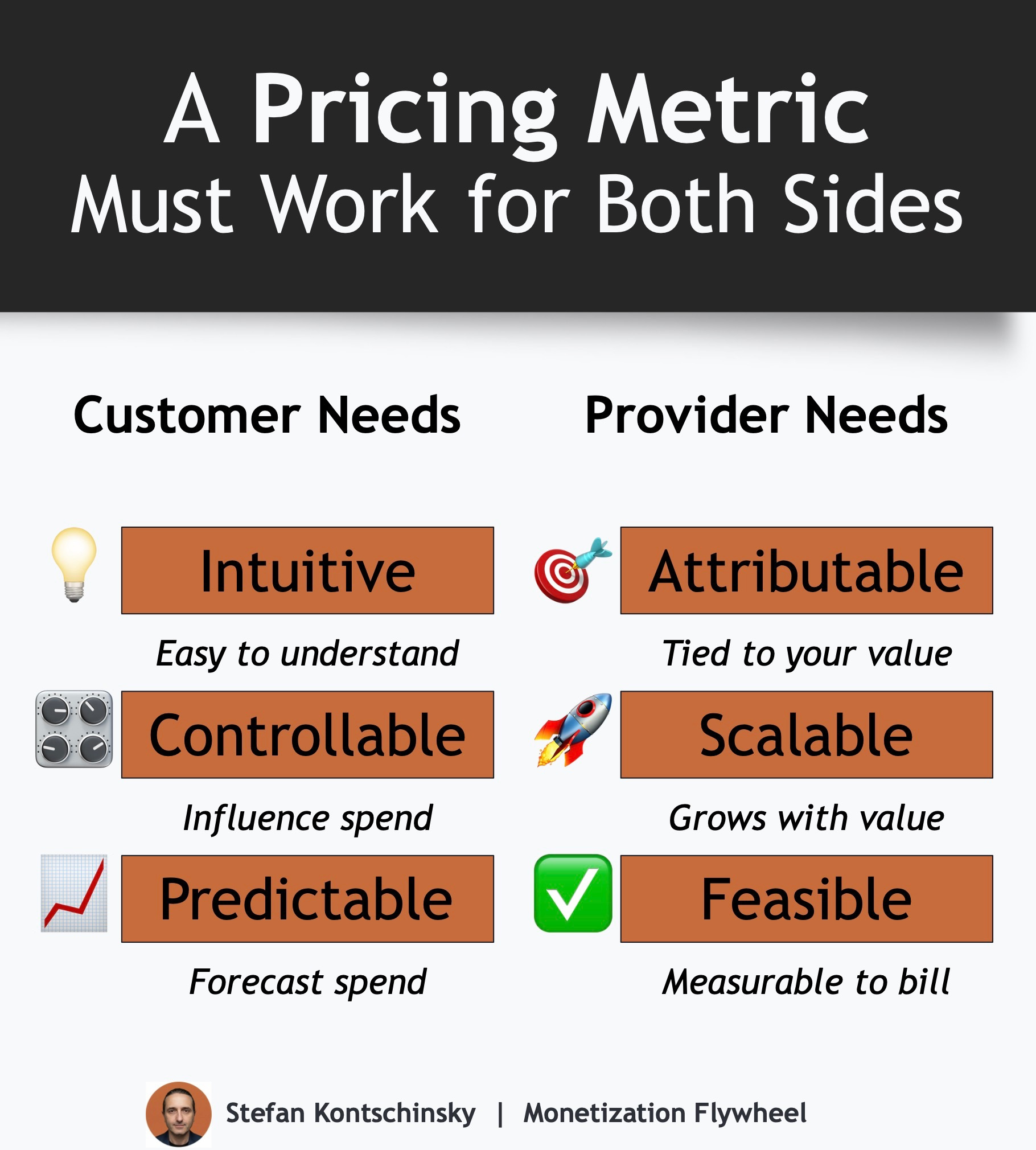
Customer-facing criteria
Intuitive
Is easy to understand and meaningful to the buyer persona
Reflects how customers perceive the value your product creates
Controllable
Customers can influence what they pay through their behavior
Feels reasonable relative to the perceived value received
Predictable
Does not vary materially due to inputs outside the customer’s control
Customers can forecast future spend within a reasonable range
Company-facing criteria
Attributable
The metric captures willingness to pay across segments and use cases
It helps isolate and monetize the value your product creates
Scalable
The metric increases as your product creates more value over time
You can reasonably control and forecast the cost-to-serve
Feasible
The metric is measurable within the product
You can measure it without depending on customer-reported inputs
Evaluating common AI pricing metrics with this
Once you apply the framework, you see the focus of the common AI pricing metrics:
User metrics
User metrics were a great proxy for value for SaaS providers, and they are easy to explain, control and budget for buyers. That is why they were popular in SaaS, and why they remain popular for AI in B2B, e.g. Canva as well as ChatGPT (the UI version).
However, for AI products, seats don’t track value creation well, and they cause issues for scalability and attributability. When users connect their Canva account with ChatGPT Agent, their Canva account still tracks this as 1 user seat, even though a human and an Agent both use their product. Identity providers are starting to separate agent identities from human ones, which could solve this also for pricing.
Usage metrics
Usage in AI is the best indicator for scaling revenue with cost, protecting margins when variable costs are high. They tend to also be feasible since a product can track its own usage. They are very common in infrastructure already, e.g.:
Per API call: Google Cloud API Gateway
Per duration and/or request: AWS Lambda
Per token: ChatGPT API
However, they are often not great for the customer. They tend to be overly technical (e.g. input + output tokens, API calls) and volatility causes issues for budgeting.
AI credits
To solve for volatile usage metrics, many AI companies allow purchasing AI credits. These are not a pricing metric in itself but rather a fungible resource unit that can be used for consumption later. So they’re a billing mechanism. How much one credit is worth is often not transparent or at least hard to understand, which causes issues to connect back to perceived value for the customer.
Outcome metrics
These tend to be more intuitive and controllable for customers, and also easier to predict because they are close to the customer value, e.g.:
Per successful payment: Stripe
Per recovered chargeback: Chargeflow
Per customer resolution: Intercom Fin AI
The challenge for AI vendors is to define outcomes they can attribute and control the cost-to-serve for. This is where many vendors fail, as we discussed in this article.
Hybrid metrics (Platform fee + usage or outcome)
This is where many AI companies will land, but from a practical standpoint they are also NOT a pricig metric per se. They combine multiple metrics in one pricing architecture as discussed here. The still leaves the choice of which metrics to combine into one architecture unanswered.
So how do you choose your right pricing metric?
The goal is to choose the one (or combination of multiple) that balances what your customers need and what you need. Here is the process that has worked for me:
1) Create a long list of ideas of potential pricing metrics
Start listing all plausible options that align with how the customer receives value:
Outcomes
Outputs
Usage
Activity
Users
Employees
Workflows
2) Score each metric
Take the ideal pricing metric criteria and rate each one on a simple 5-point scale: High, High-to-medium, Medium, Medium-to-Low, Low.
Don’t overthink this. The point is to force tradeoff discussions.
3) Aggregate the scores
Average the ratings to create an overall view of which metrics look strongest. For example, High for Intuitive + Low for Predictable = Medium overall.
This will never be perfect, but it helps structure your discussions.
4) Model the pricing using real prospects
Consider a hybrid pricing architecture of multiple metrics (e.g. seats + outcomes) if you believe that balances the customer and your company needs best.
Then model out the financials! This is the step novice pricers skip. You need to see what pricing would actually look like for real customers with each potential metric.
5) Pick the metric that works for your customers and you
Choose the metric where the scoring indicates strong customer fit as well as strong company fit, and where the resulting pricing works best for your target customer profile.
The AI pricing metric that works
In AI, pricing power starts with charging with the right unit of value. If you choose the right metric, packaging and price points fall into place more naturally. If you choose the wrong one, even the most elegant pricing architecture will struggle.
That is why pricing teams should spend more time determining the right metric. Customers need to be able to understand it, budget for it and control their spend. Providers need a metric that tracks with value, scales economically, and works for billing.
The best pricing metric works for both sides.
This has a nice set of balanced criteria (i.e., seller and buyer) for pricing metrics. APPRECIATE the mention of me among other pricing experts.