

By Stefan Kontschinsky and Shivani Dubey
Your buyers are asking ChatGPT, Claude, and Perplexity how much your product costs.
VisibilityStack analyzed 13,867 pricing questions across 108 SaaS brands and six AI platforms, then compared every answer with the pricing published by the vendor. AI got the complete pricing right only 24% of the time.
But you can fix it.
Why does AI get your pricing wrong 76% of the time?
In 76% of answers, pricing wasn’t fully accurate. Even the starting price was only right 43% of the time, despite usually being the easiest number to find.
So where does AI source information to answer pricing questions from?
Only 29% of the sources AI cites are from the vendor’s own website. About one in five citations points to a competitor. The rest comes from review sites, software directories, comparison pages, Reddit, YouTube, and other sources.
AI is effectively building its own version of your pricing from multiple sources. If you don’t publish your pricing, someone else will.
Among 27 brands in the study that published no pricing at all, AI gave buyers a specific price 81% of the time. Brands that published pricing had 4.1x higher pricing accuracy.
“If I ran a SaaS company today, the first thing I would do is ask ChatGPT or Gemini what we cost, then click through to the pages they cite. Most leaders have never done it. The ones who do usually find a number they did not set, on a page they did not know was there, that has not been updated since their last price change. By then the buyer who saw that number has already ruled you out. You never meet them, so you never find out you lost them.”
Ameet Mehta, Co-author & Co-founder of VisibilityStack
And when AI gets a price wrong, a third of misquotes are too high. That can get you filtered out from a buyer’s shortlist before they even visit your website or speak with your sales team.
So what can you do?
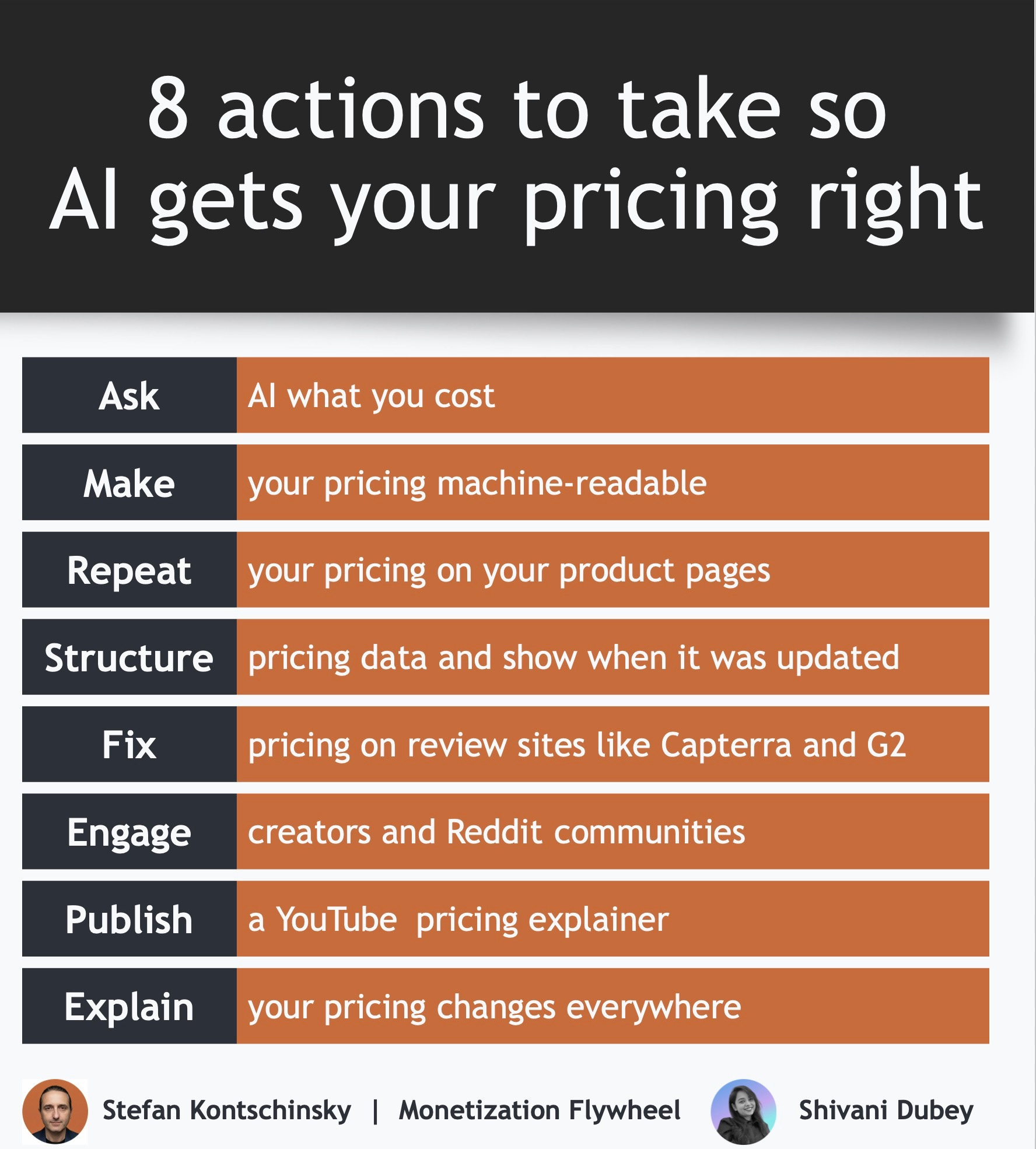
The 8 actions to fix it
To get AI to quote your pricing correctly, do three things: audit what it says today, make your own pricing easier to retrieve, and fix or outweigh outdated information elsewhere.
1. Ask AI what you cost
This is probably the easiest place to start. Open a fresh conversation in ChatGPT, Claude, Perplexity, Gemini and Google (in AI mode) and ask what a prospective buyer would ask.
Copy and paste this prompt:
I’m evaluating [COMPANY]’s [PRODUCT] for a business with [NUMBER OF USERS / EXPECTED USAGE] in [COUNTRY].
How much should I expect to pay? Break down the available plans, monthly and annual costs, what’s included, minimum commitments, potential overage charges, and any additional fees I should budget for.
Then ask a follow-up:
What sources did you use for these prices? Give me the direct links for each price or estimate.
Compare the answers against your actual pricing. Record the incorrect answers and, critically, the sources AI cites. Repeat the same test across multiple AI platforms. That tells you which errors you actually need to fix.
VisibilityStack recommends repeating the same audit every month. In this article, Stefan walks through how you can automate pricing tasks like this with the AI of your choice. Once automated, you can even run it weekly or daily.
2. Make your pricing machine-readable
Your pricing needs to work for two audiences: humans and machines.
Humans get the polished experience. Product cards, pricing calculators, comparison tables, and interactive selectors.
AI should get a machine-readable, crawlable version in plain text: plan names, pricing metrics, included usage, overage rates, and billing rules.
Cloudflare is a good example. Its pricing page is designed for humans, and AI agents can request a text-only index.md.
Give humans the polished pricing experience. Give machines a clean markdown version.
3. Repeat your pricing on your product pages
Many companies have a single pricing page. That simplifies maintaining it, and also makes it easy for buyers to find all pricing information in one place. For AI, it can make it harder to match individual products and features to the correct pricing.
Anthropic does this well. Each model page includes the pricing for that specific model (like this .md file for Fable 5.1), and an overview llms.txt file points AIs to ALL .md files. They also still have ONE consolidated pricing page for humans designed for the buyer (individual, developers, teams, API).
In addition to your pricing page for humans, repeat the relevant pricing wherever you describe an individual product.
4. Structure your pricing data and show when it was updated
Use structured data to make your pricing explicit, and signal the information is current.
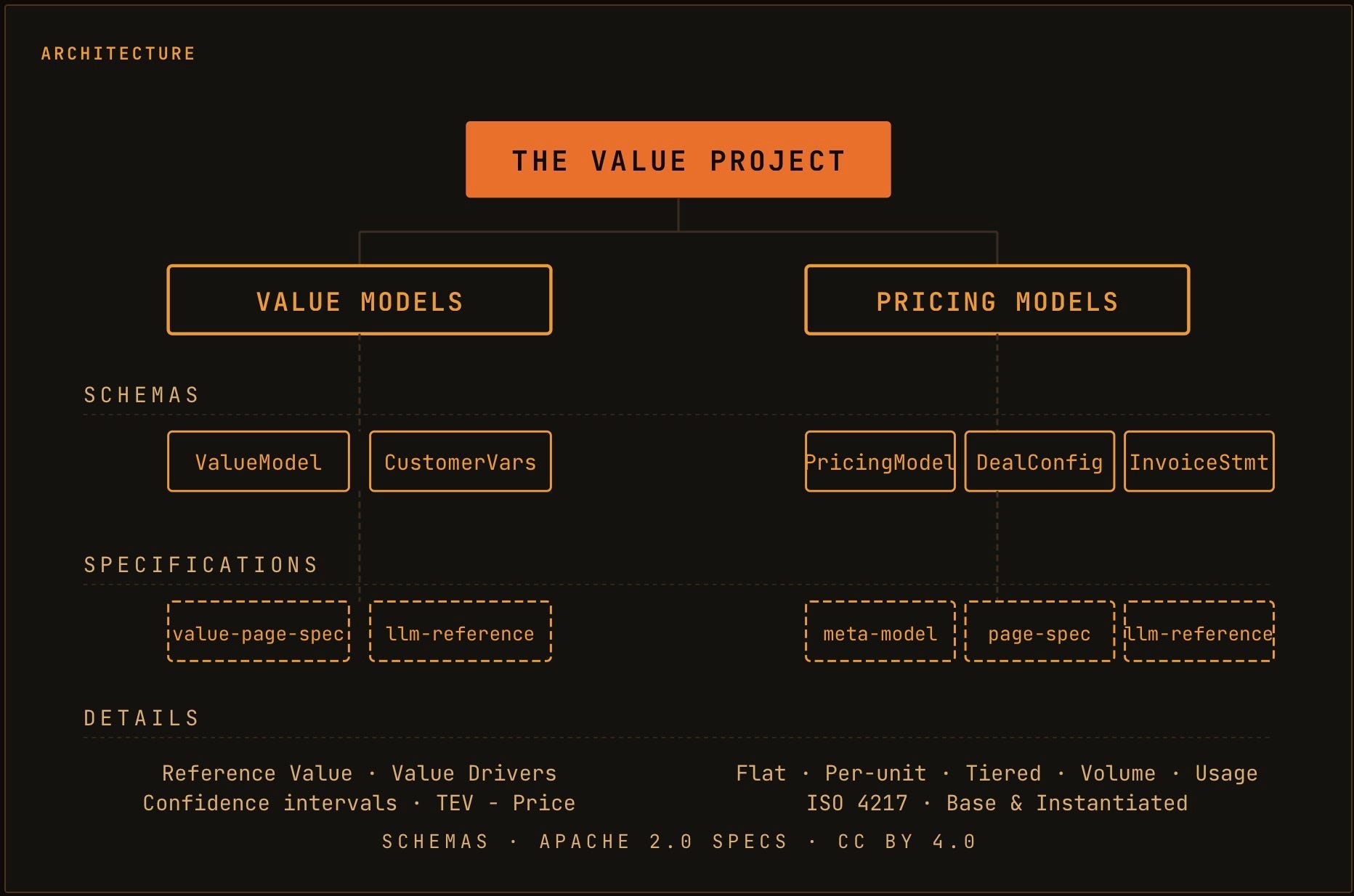
The Value Project provides open JSON schemas for machine-readable pricing and value models, all available on GitHub.
And add a dateModified to show when information was last updated (not necessarily when your pricing changed). That gives AI a stronger signal that your page is more current than a years-old comparison article.
5. Fix pricing on review sites like Capterra and G2
VisibilityStack found that every contact-sales brand it checked had pricing published on Capterra or G2 anyway.
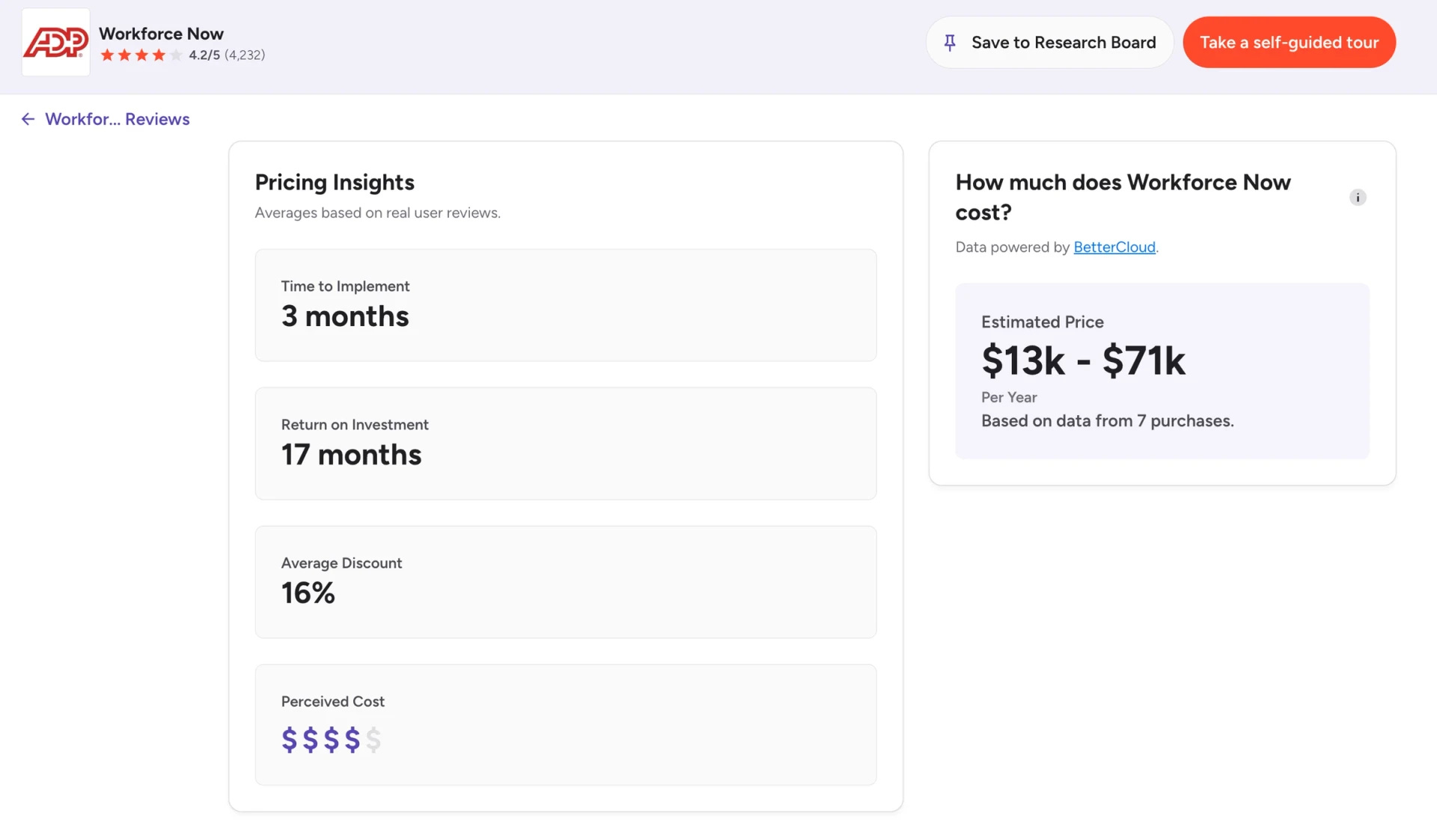
Prioritize the directories that already appear in AI answers. Claim the profiles you can control, and audit them after every pricing change. If an outdated number is posted online, AI may treat it as current.
6. Engage creators and Reddit communities
VisibilityStack found that Reddit and YouTube account for 16% of pricing citations. Another study found that the average Reddit thread cited by AI had 33 comments but only 7 upvotes, while 96% were plain-text posts. Discussion matters more than virality.
Find Reddit threads and YouTube videos that mention your product pricing. If they’re wrong or outdated, engage transparently as the vendor and provide the current information.
If creators have already covered your product, give them a reason to revisit it with the current pricing.
7. Publish a YouTube pricing explainer
Create a simple video explaining your plans, actual prices, and who each plan is designed for.
Clay Co-founder Varun Anand and Head of Finance Karan Parekh made this YouTube video explaining their new pricing model when they split out platform actions from their pricing.

8. Explain your pricing changes everywhere
When Clay changed its pricing in March 2026, it explained the change in an 8-minute video, a launch announcement, an internal pricing memo, multiple FAQs, its Community, Clay University, and LinkedIn posts.
That repetition matters. Each becomes another current source AI can retrieve when someone asks why your pricing changed or what an existing customer should expect.
When pricing changes, update your pricing page and talk about it - in multiple pages.
Your pricing strategy is no longer communicated only through your pricing page and your sales team alone. AI is explaining it for you, so make sure it has the right information.