

Ask five pricing leaders where the function should sit and you get five answers. So I went and counted. I pulled 116 pricing strategy roles from live job descriptions for AI-native and SaaS companies, categorized those by scope, industry, ownership, and business model. And I started seeing some patterns.
What the experts found, and what they left open
Simon-Kucher reported in 2024 that pricing has “a pretty even distribution of functional homes across B2B organizations.”
BCG found the same in 2017. Pricing reports either to the CEO, or to sales or marketing or is embedded in the finance department.
Homburg, Jensen, and Hahn in “How to Organize Pricing? Vertical Delegation and Horizontal Dispersion of Pricing Authority” found that strategic pricing and transaction-level discount authority need different governance. Delegate too much and margin leaks. Delegate too little and deals stall.
That last point gave me an idea. When overall there is no dominant function, what factors impact where pricing should sit. Here is what I found.
Scope decides the reporting line
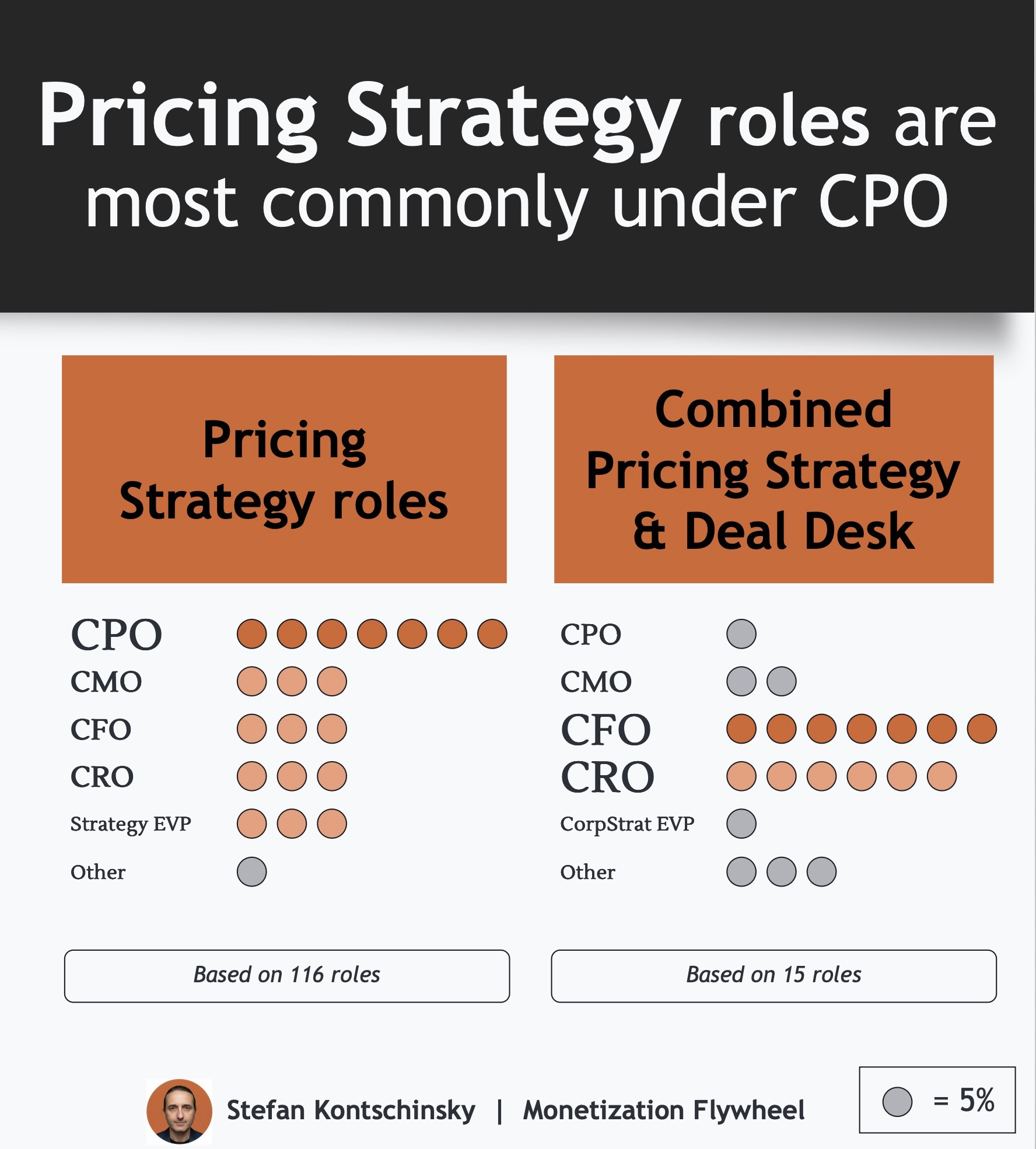
In this dataset of job descriptions, the CPO is the most common home for a pricing strategy role at 35%. But that means 65% of the companies put pricing somewhere else. CMO, CFO, CRO, and Strategy EVP are all at roughly 15% each.
Pricing strategy roles that also own deal desk responsibilities report much more often to the CFO (33%) or CRO (27%). A deal desk structures deals, approves discounts, weights trade-offs with payment terms. That work lives next to revenue recognition and quota attainment, so the reporting line follows.
Homburg’s paper called this the difference between strategic authority and transaction-level authority. Companies are organizing exactly that way. If you are hiring a pricing leader, be clear if the job is the former or if it includes the latter too. One word of caution: Very few Pricing experts have experience in both.
An industry-focus moves pricing away from CPO
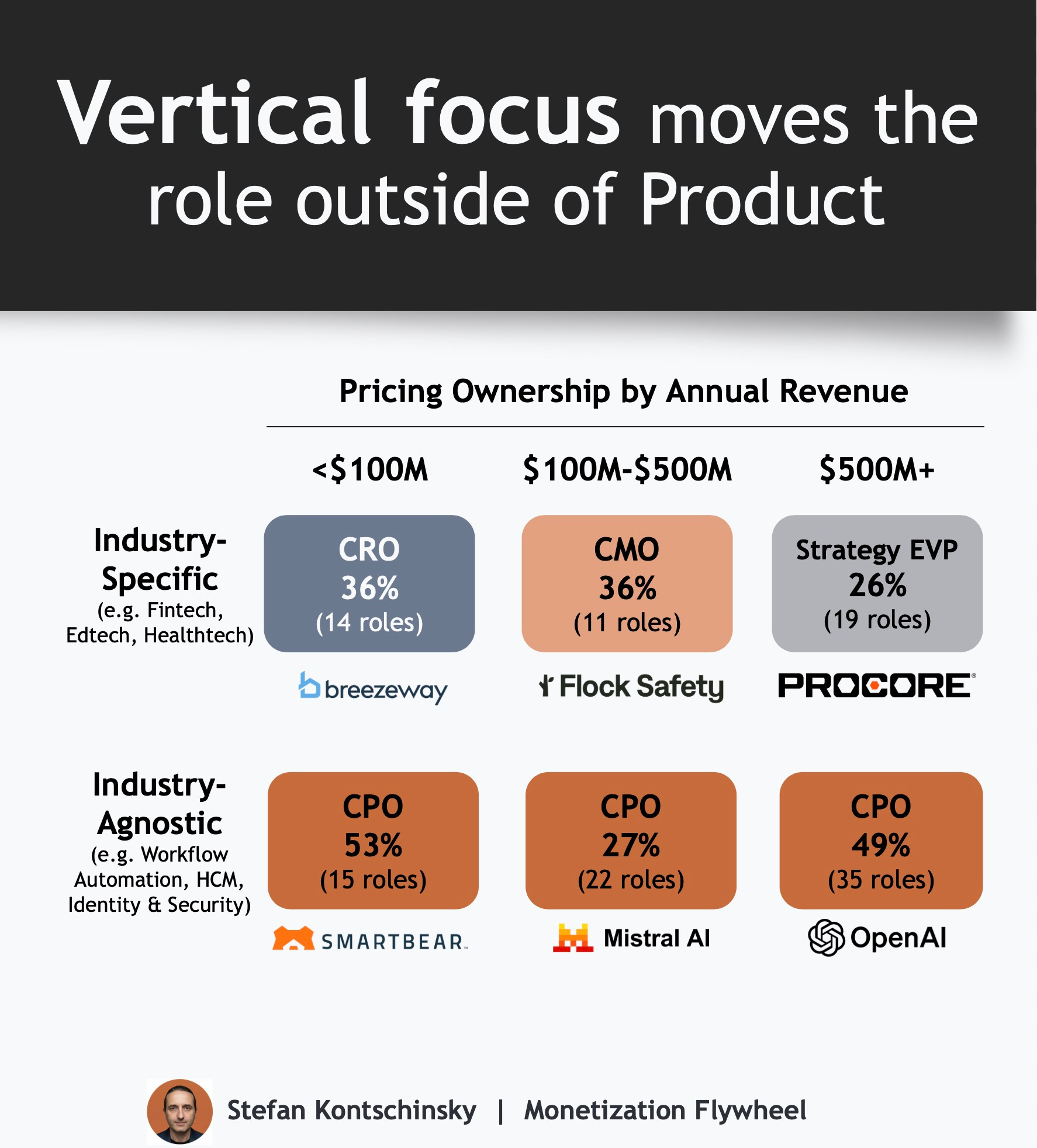
Industry-agnostic companies put pricing under the CPO at every stage: SmartBear below $100M, Mistral at $400M, OpenAI at $25B.
Industry-specific companies don’t. Below $100M, the most common home is the CRO at 36%. Between $100M and $500M it is the CMO at 36%. Above $500M it lands with Strategy EVP at 26%, with CPO and CFO close behind.
The mechanism I suspect is the buyer and their budget. Vertical software gets priced against a budget line that already exists inside the customer’s business. Breezeway sells into property operations, where the comparison is a labor cost. Flock Safety sells to police departments and municipalities, where the comparison is a public budget. Procore sells into construction, where the buyer already funds project management. Whoever knows the customer’s budgets best, ends up owning pricing.
AI-native companies have not settled it
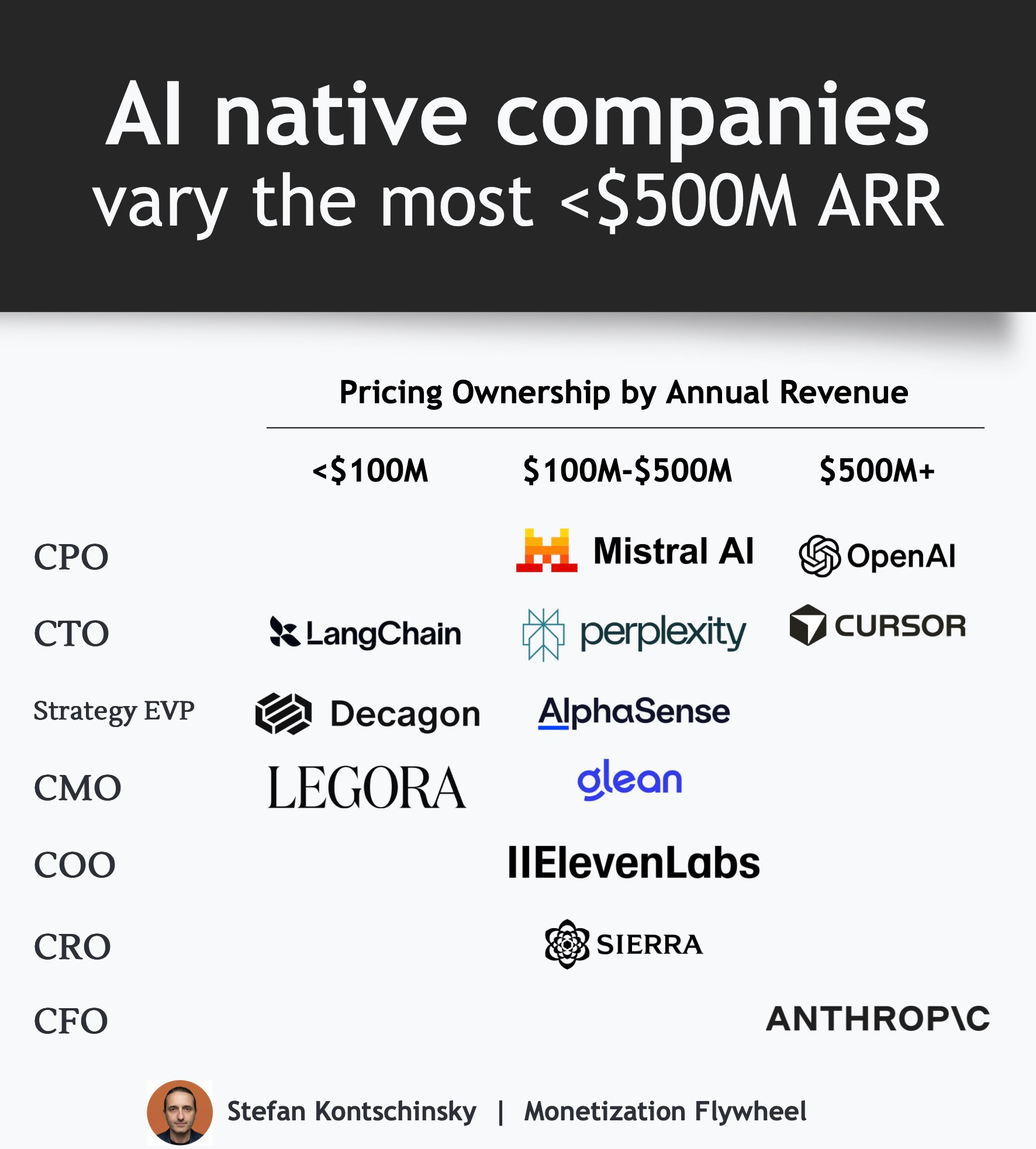
Below $100M, three roles of AI-native companies land in three different places: Legora hires a Sr. PMM for Pricing & Packaging under the CMO, LangChain hires a “Senior Fullstack Engineer, Growth & Monetization” under the CTO, and Decagon hires their first pricing hire in their Business Operations team. Each have a different focus - packaging optimization vs. pricing experimentation vs. deal structuring.
Between $100M and $500M fragmentation continues. Six roles, six homes. Mistral under the CPO. Perplexity under the CTO. AlphaSense under Strategy EVP. Glean under the CMO. ElevenLabs under the COO. Sierra under the CRO.
Only above $500M do you start seeing a pattern. CPO becomes most common with 50%, CFO at 33%, CTO at 17%. OpenAI actually has multiple pricing roles under the CPO and the CFO. Cursor keeps it under the CTO. Anthropic runs it under the CFO.
AI-native companies price against a cost curve that moves rapidly, so the person who owns inference economics is critical to understand economics with growth. Metering and rating also is critical for usage-based AI pricing. That is why pricing is under a CTO at a coding tool. And beyond $500M, product strategy and gross margin are what investors ask about, which explains the function sitting in again product & finance.
Company ownership affect who owns pricing
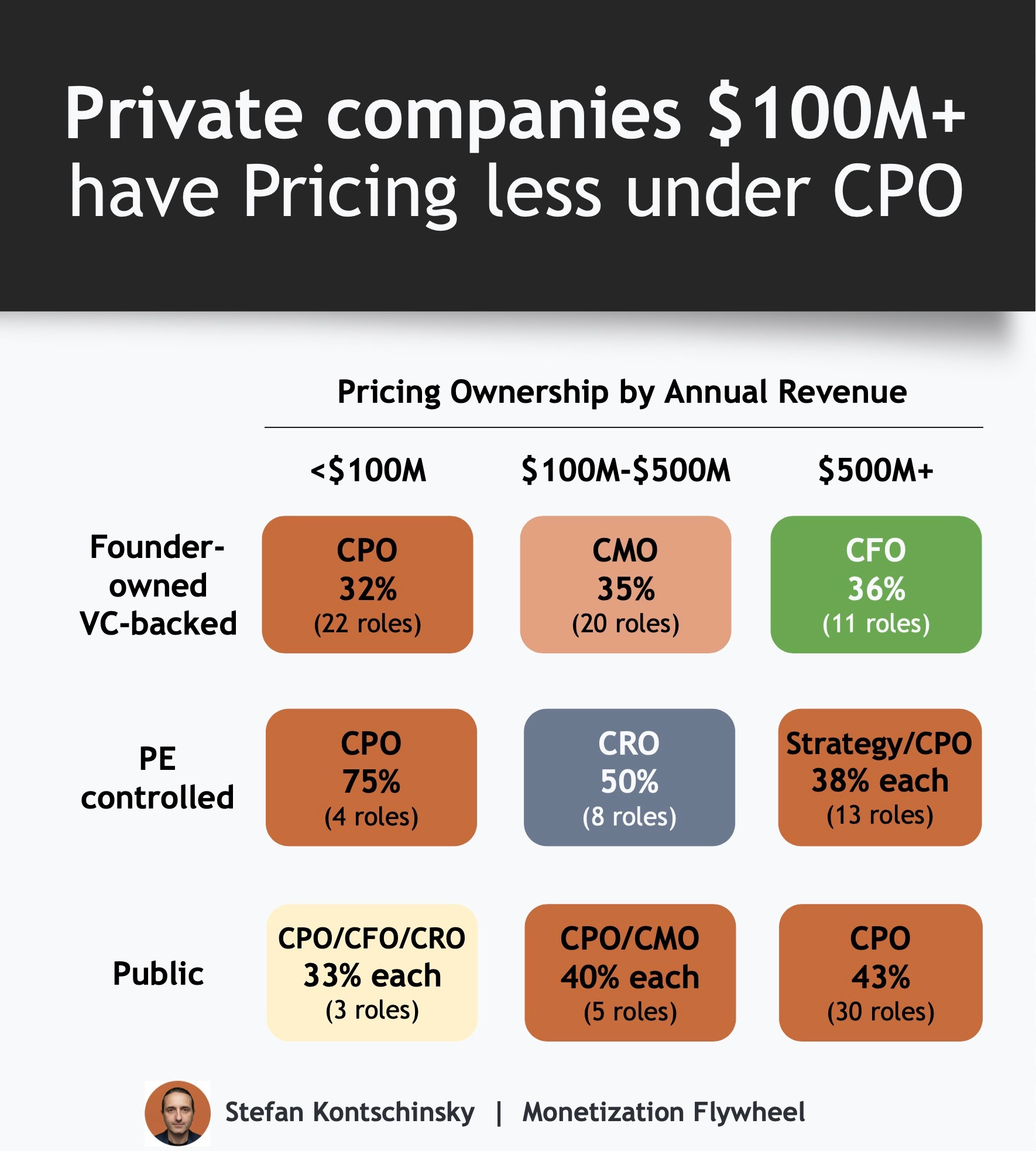
Among founder-owned and VC-backed companies, the most common home for pricing depends on the size / stage. Below $100M, it is the CPO at 32%. Between $100M and $500M, the CMO at 35%. Above $500M, the CFO at 36%. The smaller ones focus on growth, the large ones shape their financial story for an exit.
PE-controlled companies want change fast. Between $100M and $500M, half report to the CRO. Post-buyout, price realization through sales discipline is the fastest lever to optimize: reduce discount leakage for new deals, push for more renewal uplift. Above $500M it splits evenly between Strategy EVP and CPO at 38% each - at this stage, a coherent pricing strategy across a portfolio is a big lever by itself.
Public companies between $100M and $500M prefer Pricing roles under the CPO and CMO at 40% each. They are closest to customer needs and decide what to build and launch next. Above $500M the CPO still leads with 43%, but the CMO loses share likely because their focus at that scale moves further away from Product Marketing.
The first pricing hire happens earlier than you think
Out of 17 confirmed first-time pricing hires, 47% were at companies below $100M ARR and another 35% were between $100M and $500M. The median for first time hire Pricing roles in this dataset is $132M ARR, the top quartile is $36M ARR.
Companies also hire a pricing strategy role before an exit. 82% of first-time pricing roles were at founder-led, VC-backed companies, even though those companies made up only about half the JDs in the dataset. A dedicated pricing role before an exit strengthens financials, ensures consistency, and signals maturity.
At scale, one owner stops working
OpenAI and Google both have multiple C-level pricing homes. OpenAI splits product pricing from GTM and finance pricing. Google splits Cloud business pricing from AI product monetization.
Such federated pricing appears at large companies once the product portfolio outgrows a single buyer. AI subscriptions and cloud infrastructure are sold to different buyers and are also quite different on the cost side. Splitting the pricing roles under two executives can drive collaboration across functions, with each function optimizing for its own price.
What to do with this
The reporting line is a design decision, so make it on purpose:
If you are a founder, start out with pricing early under the CPO or CMO.
If you are industry-specific, hire under who knows the customer’s budgets.
If you are AI-native below $500M, align it with who owns your unit economics.
If the role approves deals, hire under the CFO or CRO for margin discipline.
If you are PE-backed, hiring under the CRO might fix price realization fastest.
If you are past $500M with multiple product lines, you likely need multiple homes (e.g. CPO for product pricing + CFO for GTM pricing).
Closing Thought
Pricing has no one dominant home, but it depends on four things you can actually check. Whether the role owns deal approval, whether you sell to one industry or many, how much revenue you have, and who controls your cap table.
One caveat on all of it. These insights come from analyzing job descriptions, so they capture where companies are actually hiring pricing leaders right now. With AI reshaping how companies price, we might see these patterns shift over time.
For now, it is what I would trust. It beats relying on gut instinct. Answer those four questions and you know where pricing should sit for you specifically.


Amazing study man! This is a great contribution to the industry. Congrats on the fantastic work — really insightful and valuable! Best regards from Sao Paulo BRA.