

Don’t default to usage pricing for AI just because your variable costs are high. Start by deciding which charges should make up your commercial model to protect margins while matching how customers adopt. Most B2B deals combine three recurring and three one-time / usage-based components.
Use this guide to design your pricing architecture to support predictable revenue and profitable growth in your reality:
Is your customer’s demand seasonal?
Do “power users” consume multiples of everyone else?
Is usage hard to forecast for customers, and your marginal costs are high?
Do you incur meaningful costs even for small accounts?
Do your enterprise customers need 24x7 expert support and strict SLAs?
Do your customers want budget predictability?
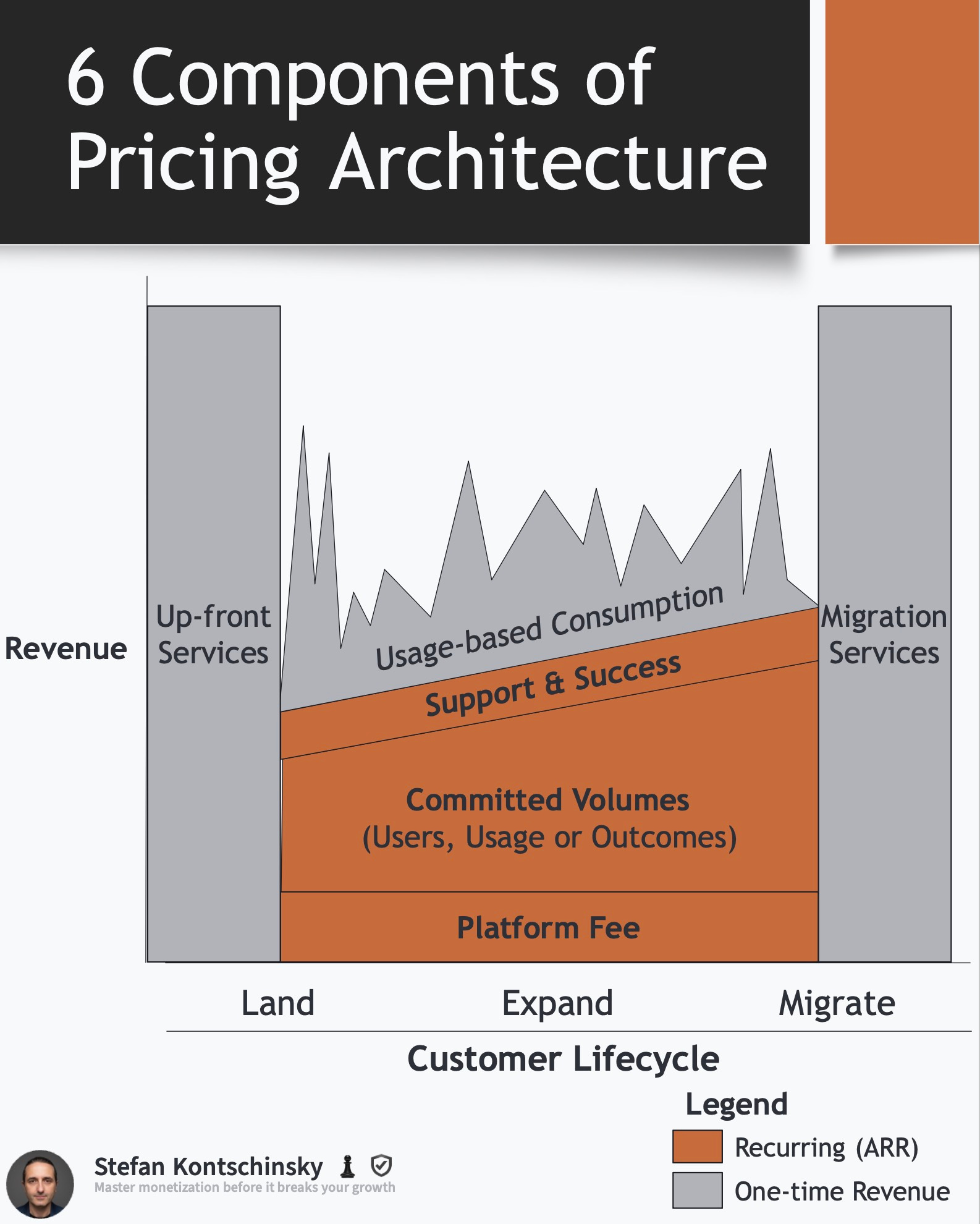
Recurring Subscription Components
1) Committed Volumes (Users, Usage or Outcomes)
A recurring contract with committed volumes in a chosen metric. The defining feature is committed recurring revenue, not the unit of measure. Recurring credit bundles can fit here if they are contracted and revenue-recognizable under ASC 606.
Examples:
Lovable Pro is $25 for 100 credits per month
Zendesk AI Agents are $1.50 per committed automated resolution
2) Platform Fee
A fixed recurring fee that captures baseline value and helps cover non-scaling costs. There are 3 common variants:
2-part tariff: platform fee does not include any usage
3-part tariff: platform fee includes base allowance, overages are billed
All inclusive: unlimited use, protected by rate limits or a fair use policy
Examples:
NextMatter charges 7,500 EUR per month, in addition to per user charges
Basecamp Business is $299 per month all-inclusive
3) Support & Success
Paid support subscriptions layered on top of licenses. These are typically priced as a % of product spend and tied to access, SLAs, and expert resources.
Examples:
Microsoft Unified Enterprise Support is ~7.5-10% of product spend, min $50k
Salesforce Premier Success Plan is 30% of license fees
One-time Revenue Components
4) Up-front Services
One-time services for onboarding, integration, testing and training.
Examples:
Factor A/E charges a one-time implementation fee plus subscriptions
Link2Feed requires a one-time implementation fee on top of its subscription
5) Usage-based Consumption
Pay-as-you-go with no upfront volume commitment. These are common for variable or AI usage and value-added services.
Examples:
OpenAI API calls are priced per 1M tokens and usage is billed monthly
Amazon Bedrock Flows: $0.035 for 1k node transitions, metered & billed monthly
6) Migration Services
One-time services to extract, transform, or move data, or fees for data egress or assisted migration.
Examples:
MongoDB Atlas charges $0.125 per GB exported plus transfer fees
AWS Snowball Edge export jobs are priced per device fee plus shipping
Closing Thought
Let’s go back to our questions from the beginning. Here is how you can design you pricing architecture so revenue is predictable and your business grows profitably:
Is your customer’s demand seasonal? → Use subscriptions with annual caps
Do “power users” consume multiples of everyone else? Offer pooled allowances
Is usage hard to forecast for customers, and your marginal costs are high? → Offer committed credits with mid-term top-ups (pre-priced incremental add-ons)
Do you incur meaningful costs even for small accounts? → Add a platform fee to cover non-scaling cost
Do your enterprise customers need 24x7 expert support and strict SLAs? → Consider an Enterprise Support priced as a % of ARR with a minimum
Do your customers want budget predictability? → Price committed volumes significantly lower than pay-as-you-go rates