

Where we Stand on Outcome-based Pricing
Outcome-based pricing isn’t theoretical anymore.
Buyer Preference: Andreessen Horowitz found that in summer 2025, usage-based pricing (e.g. by token, API call) has overtaken seat-based pricing already as the preferred way to purchase AI (39% vs 21%). That’s a big change from SaaS pricing that was predominantly per user. What’s even more surprising is that 15% of CIOs actually preferred outcome-based pricing (e.g. per lead, resolution, task completion), and another 23% a hybrid (a mix of seat/usage/outcome pricing).
Adoption: The reality check from Ibbakka found in September 2025 that only 3% of companies charge directly for outcomes so far. Andreessen Horowitz identified the 3 biggest challenges with outcome-based pricing:
Lack of clear measurable outcomes
Unpredictable or unscalable cost
Difficulty attributing value to a specific tool or model
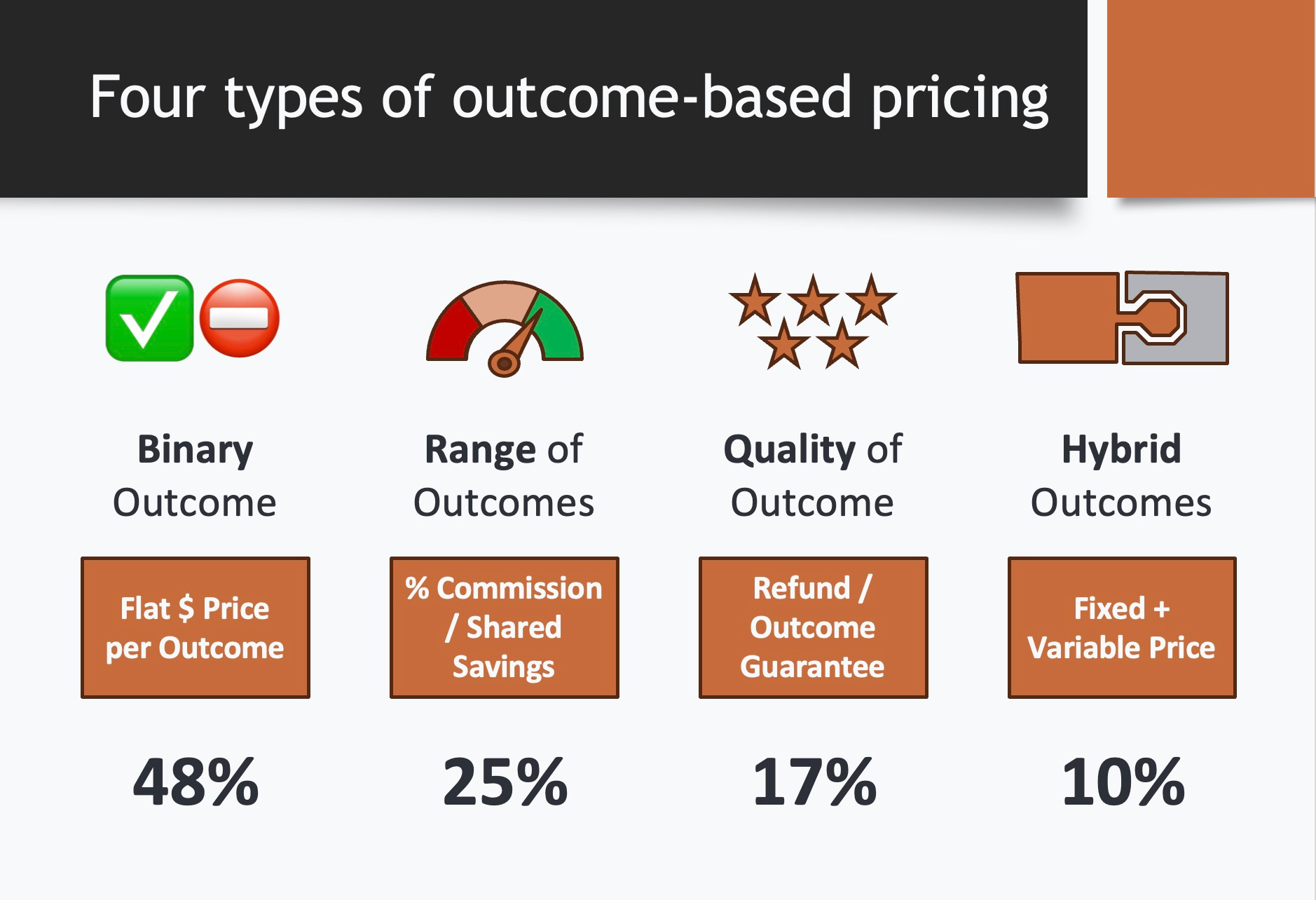
Despite these challenges, many companies across a broad range of industries have successfully adopted outcome-based models. Across 100+ companies from our 2025 database that use outcome-based pricing:
~48% charge a fixed price per outcome (e.g., identity verified, action completed)
~25% charge a % of the achieved outcome (e.g., revenue uplift, cost savings)
~17% offer refunds or outcome guarantees, tying compensation to risk
~10% leverage a hybrid of fixed and variable outcomes to balance components
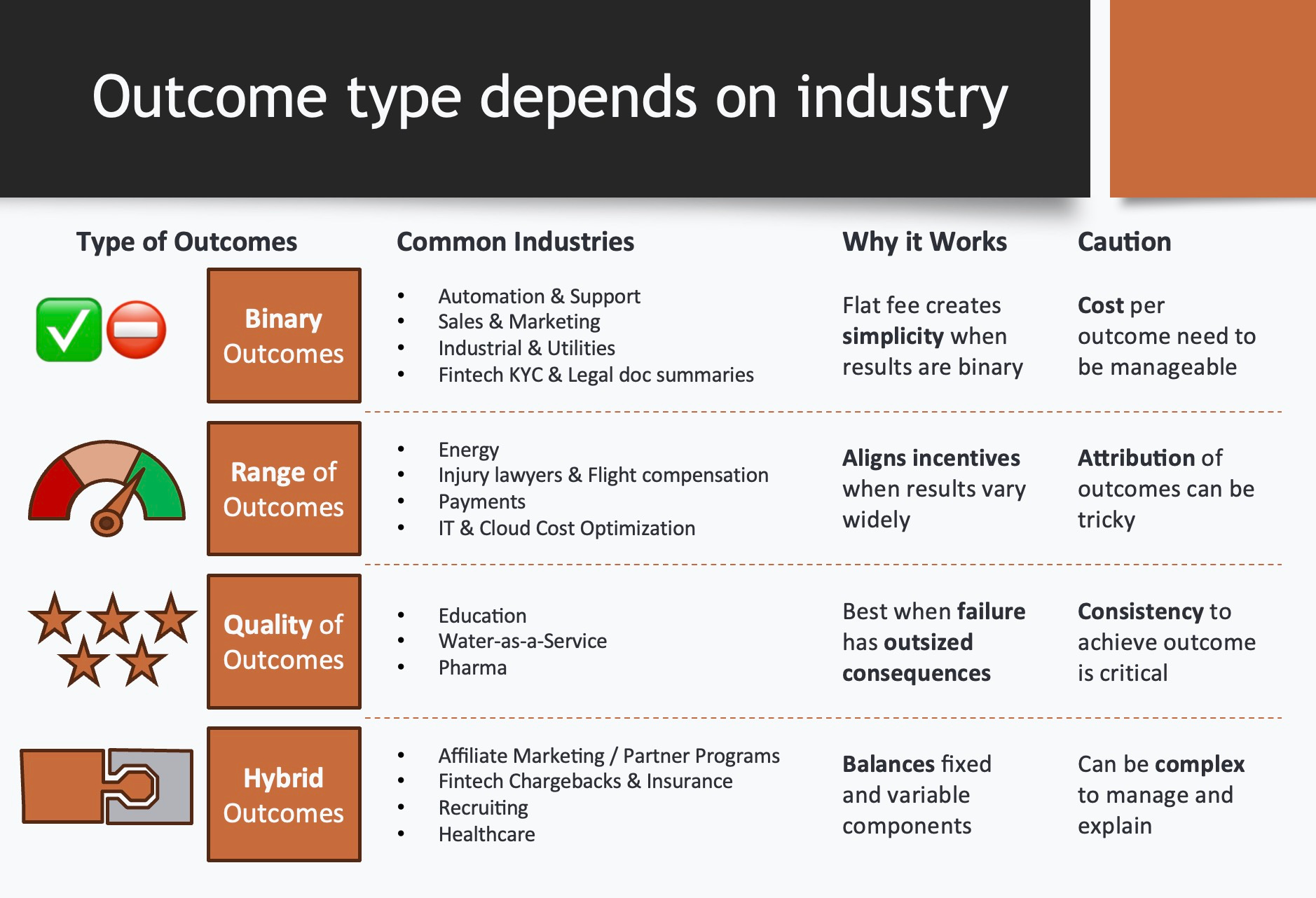
Pricing consistently aligns with the nature of the outcome in each industry. Across industries, pricing models track the measurability of the outcome: binary results favor fixed fees, variable results favor revenue shares, and high-risk outcomes demand guarantees.
Binary Outcomes
In some industries, outcomes are binary - it was either achieved or not. The outcome doesn’t range qualitatively, there is no half way done. So a flat fee per outcome is optimal.
A flat price per outcome has become a prominent pricing model in quite a few industry use cases:
In the Automation & Support space
Customer Service charges for tickets resolved automatically (Zendesk, Decagon)
Workflow Automation charges for workflows or steps completed (n8n, Relay)
Cybersecurity charges for valid vulnerability reported (Intigriti, HackerOne) or security tests completed (Synack)
Image Editing charges for images edited or retouched (Imagen, Luxedit)
In the Sales & Marketing space
Performance Advertising charges cost per click or cost per action (Google Ads, Outbrain)
SDR AI charges for meetings held or tasks completed (ChaseLabs, Funnl)
Software Marketplace Lead Gen charges for leads or qualified demo requests (SoftwareAdvice, GetApp)
In the Industrial and Utilities space
Aerospace & Defense charges for engine flight hour (RollsRoyce, GE) or cargo delivered successfully (SpaceX)
Carbon Credits charges per metric ton CO₂ removed (Climeworks, Indigo Ag)
Compressed Air charges per compressed air consumed (AtlasCopco, Kaeser)
Fleet Management charges per mile driven (Michelin Fleet)
In the Fintech and Legal spaces
Know Your Customer (KYC) charges per verified identity (Idenfy)
Legal Doc Summaries charge per deliverable summary (CaseMark)
Legal Demand Drafts charge per demand package or medical chronology (EvenUp)
Why it works: Because the outcome is binary (achieved or not), a flat fee creates simplicity and predictability for both sides, turning performance into a measurable unit of delivery. This model offers predictable revenue recognition and low billing friction, which is ideal when the cost to deliver is stable and outcomes are binary.
Range of Outcomes
In other industries, it is not just the question of whether the outcome was achieved, but outcomes range a lot. A personal injury lawyer did achieve an outcome if he gets a $100k settlement, but another might have gotten a $10M outcome. In these cases, a % of the outcome is the best way to align pricing with value. This model pushes risk to the vendor and aligns incentives to maximize the potential outcome. It works only if attribution is airtight.
The use cases where a percentage of the achieved outcome is a prominent pricing model include:
In the Energy space
Energy companies charge for % of energy savings achieved (Siemens, Budderfly)
Lighting-as-a-Service providers charge for light generated (Signify, Stouch)
In the Fintech space
Payment companies charge a % of successful transactions (Stripe, Flycode)
IT & Cloud Cost Optimization providers charge a % of verified or achieved savings (Zesty, ProsperOps)
In the Legal space
Personal Injury lawyers charge for a % of the achieved award (Morgan & Morgan, Brown&Crouppen)
Airline Flight Claims companies charges for a % of the successful compensation (AirAdvisor, AirHelp)
Why it works: When results vary in magnitude, tying price to a percentage of the achieved outcome directly links value capture to value creation and scales incentives proportionally. This model scales naturally with customer value, aligning incentives and sharing upside when outcomes vary in magnitude.
Don’t define outcomes you can’t attribute.
Quality of Outcomes
In some industries or use cases, the outcome is expected, but a negative outcome can have dire consequences. For example, a water facility providing clean water 99.99% of the hours in a year is not sufficient given that would imply unpotable water for one hour every year. One hour of undrinkable water equals a year of lost trust.
In these cases, having a disproportionate refund (i.e., a penalty) might be required to get customers to get comfortable with outcome-based pricing.
Some examples of where a refund or outcome guarantee is prominent are:
Education guarantees a job (Springboard) or a minimum income after graduating (BloomTech)
Water-as-a-Service refunds for low water quality (Veolia, Xylem)
Pharma provides refunds or rebates for negative clinical outcomes (Amgen, Merck)
Why it works: Where failure has outsized consequences, refunds or penalties build buyer trust and de-risk adoption, signaling confidence in the product’s ability to deliver. This model builds trust in high-stakes scenarios, de-risking adoption and signaling confidence through accountability. It only works when you can commit with high confidence.
Hybrid Outcomes
Some industries also blend fixed and variable elements to balance predictability with upside. Examples of these include:
The same company blends fixed and variable outcomes:
Affiliate Marketing / Partner Programs pay oftentimes both, a % commission and a fixed fee for specific actions (Amazon Associates, Shopify Partner)
FinTech chargebacks can be a flat fee for prevented chargebacks and a % of the amount for recovered chargebacks (Chargeflow)
Companies differentiate from competitors by using a different outcome-metric:
Insurance companies vary from charging per miles driven (Metromile) to a % based on driving behavior (Root Insurance)
Recruiting firms charge a fixed fee per placed candidate (Marloes) or a % of first year salary (Nigel Frank)
Healthcare varies from charging a flat fee for signups from at-risk members (Omada Health) to % of cost savings achieved (Hinge Health) to % incremental revenue from (SmarterDx)
Why it works: Blending fixed and variable components lets companies balance predictability with performance upside or position themselves as better aligned with the outcomes their customers care about. The fixed fee secures recurring revenue, while the variable layer links earnings to measurable outcomes. This turns pricing into a competitive differentiator rather than just a contract term.
Final Thought
Outcome-based pricing is already working for many companies. The ones mastering it aren’t chasing the hype, they’ve made outcomes their unit of value. They’re charging for outcomes that matter to their customer base.
Winners operationalize value measurement. They manage risk (AI cost), customer alignment (outcome attribution), and cash flow (billing) as integrated parts of monetization design - we explored the latter in Untangling billing and pricing. They build systems that measure, attribute, and monetize value delivery with precision.