

Anthropic and OpenAI charge 10% extra for regional processing. Google Cloud charges 20% for FedRAMP High. Microsoft Foundry charges up to 50% more for AI inference in certain regions.
What are they charging for? And how should you price sovereignty for your products?
Why does sovereignty cost more?
Sovereignty requirements vary. Some customers need their data stored in a particular country boundary, others have specific citizenship requirements for support staff, and some require an isolated environment to handle sensitive government information.
These requirements create additional costs for AI and SaaS vendors. Less flexibility to share capacity globally or across customers requires additional investment in infrastructure, and local support teams with access controls increase ongoing costs.
Sovereignty also creates customer value and differentiation: Some customers in certain industries, government agencies and their mission partners are unable to use some products unless they meet certain certifications. Obtaining these can be expensive but differentiate your offer against a competitor that lacks these.
Many SaaS and AI companies charge a percentage premium, while some have fixed annual fees. Let’s look at three types of offerings and what vendors actually charge.
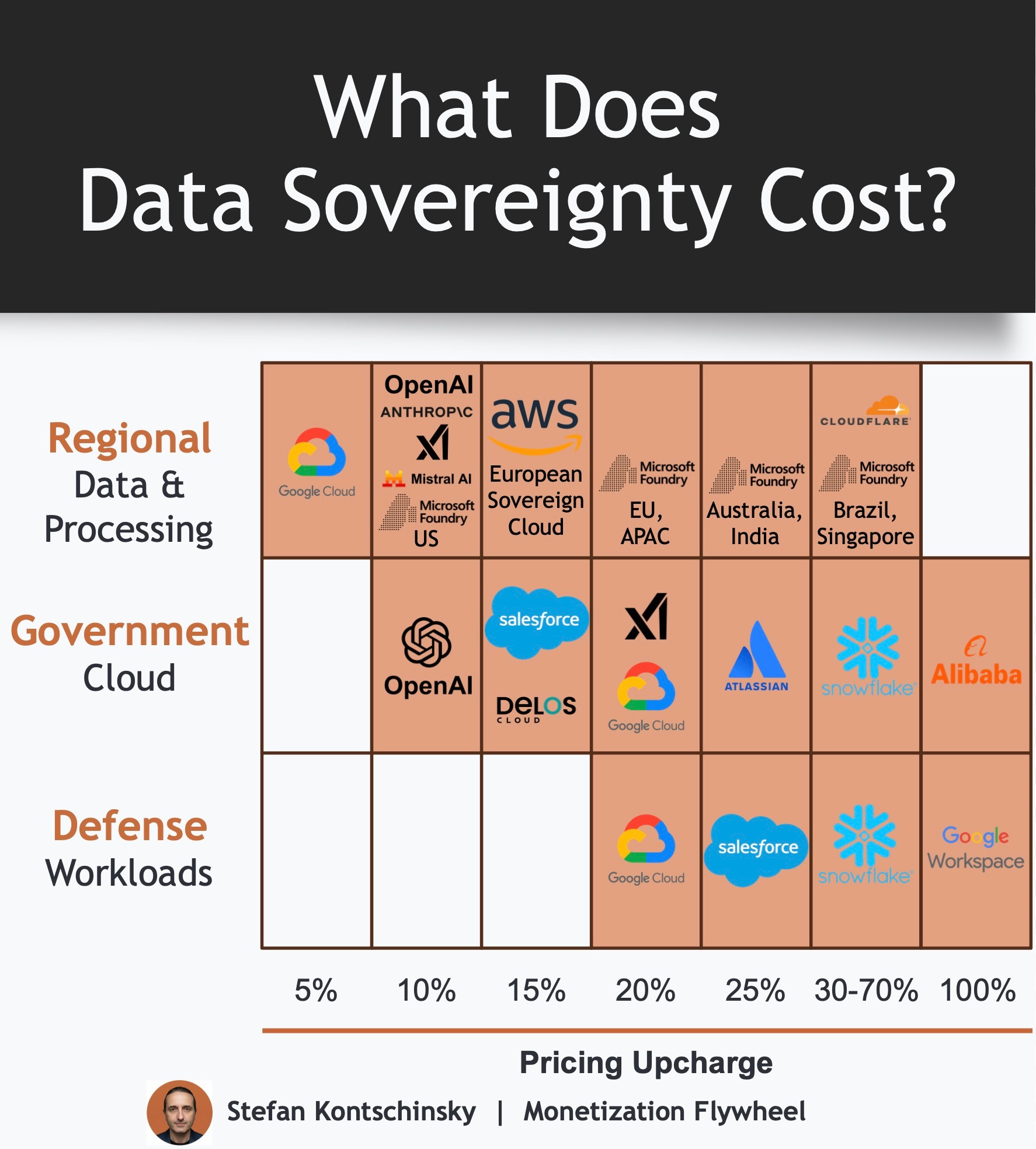
1. Regional Data & Processing: +5% to +50%
Regional processing restricts where data is stored or processed. AI providers offer regional inference within a specific geography, and they typically charge extra for that.
AI and SaaS providers take one of four approaches:
A flat percentage: Most AI vendors charge 10% for regional inference, but support and administrative access can still be provided from other regions:
OpenAI: Regional API processing +10%
Anthropic: US-only Claude inference +10%
Mistral AI: Regional inference +10%
xAI: US regional inference +10%
AWS: European Sovereign Cloud +15% (average across six services)
Cloudflare: Data Localization Suite +30%
Upcharge for Regional Support: Google Cloud offers regional data boundaries for free, charges 5% for regional support. That also requires one of Google’s paid support subscriptions, which costs another 3%-10%.
A percentage that varies by region: Microsoft Foundry charges
+10% for its US data zone
+20% for EU and APAC data zone
+25% to +50% for Regional/National AI deployments (e.g. Brazil, Singapore)
A fixed fee: Oracle Fusion charges $150k / year for EU / UK Sovereign Cloud
2. Government Cloud: +10% to +100%, $150k+
Governments usually require additional security controls beyond regional data residency, and some countries have different levels.
In the U.S., FedRAMP certification is common when selling to a government agency. The two most common levels I’ve seen are Class C (FedRAMP Moderate) and Class D (FedRAMP High). Foreign governments have similar needs.
FedRAMP Moderate:
Who is it for: applies to federal systems like HR applications managing federal employee records, procurement systems, or agency collaboration tools.
How is it priced:
FedRAMP High & Agency Specific policies:
Who is it for: addresses more sensitive unclassified government information like sensitive law-enforcement systems or critical government financial systems.
How is it priced:
Salesforce: Government Cloud Plus (FedRAMP High + Moderate) +15%
Google Cloud: FedRAMP High, CJIS and IRS Publication 1075 +20%
Grok 4.3: via Bedrock In-Region Inference AWS GovCloud +20%
Snowflake: Business Critical credit for FedRAMP High Plus +40%
Sovereign Cloud for Foreign Governments:
Who is it for: Governments outside the U.S. with national requirements for data residency, security controls, and operational sovereignty.
How is it priced:
3. Defense Workloads: +20% to +100%, $500k+
Defense workloads face additional security requirements beyond standard government cloud. These include DoD Impact Levels (IL2, IL4, IL5) for cloud environments, DISA STIGs for technical system hardening, and export controls such as ITAR for sensitive information.
Depending on the workload, meeting these requirements can involve U.S.-person access restrictions, enhanced security controls, or physically isolated infrastructure.
Google Cloud charges 20% extra for its Assured Workloads offering supporting DoD IL2, IL4, and IL5, and ITAR. Customers also need Enhanced or Premium Support, which adds another 3% to 10% of cloud spending depending on volume.
Salesforce charges 25% extra for Government Cloud Plus Defense, supporting DoD IL4 and IL5. For classified workloads, Salesforce offers Government Cloud Premium supporting Top Secret information, but does not publish that pricing. Its Premier Success Plan is another 30% of license fees on top.
Snowflake charges 40% more for compute credits and 70% more for storage in its DoD environment (IL5) compared with standard U.S. commercial regions. Its FedRAMP High Plus environment has the same uplift.
Google Workspace Assured Controls Plus for DoD IL4 (GSA reseller) doubles the Enterprise Plus license cost (when purchased through GSA).
Oracle charges $500,000 annually for its SaaS for U.S. Government Disconnected.
Four lessons for SaaS and AI pricing leaders
Needs of customers vary, and even the same capability can have different costs to serve and different customer value depending on where it must be delivered.
1. Package sovereignty capabilities and regional support separately
A customer needing EU data residency may not require EU-only support. Others might need both. Allow your customers to buy the level of sovereignty they need.
2. Price based on customer value
For some customers, sovereignty is a prerequisite to purchasing your product. This creates value beyond your incremental delivery costs. Price according to what these capabilities are worth to your customers, rather than simply marking up your costs.
3. Structure pricing to recover your costs
Most AI and SaaS vendors charge percentage uplifts, while Oracle prices it as a fixed fee. Percentage premiums scale with customer spending, but not necessarily with your costs. Consider percentage uplifts, fixed fees, or a combination of both to ensure you cover costs such as certification, dedicated infrastructure, and restricted support.
4. Don’t offer sovereignty if the economics don’t work for you
If the cost of delivering sovereignty exceeds what customers are willing to pay, you may not have a viable offering. Consider narrowing the scope, changing the delivery model, or deciding not to offer it at all.


