

Optimizing monetization requires mastering both pricing and billing.
Pricing defines the logic of value, what customers pay for.
Billing defines the rhythm of cash, when they pay.
The timing of collection can either fuel or constrain growth. In an era of AI unpredictability and tightening cash cycles, understanding that difference can mean the gap between scaling sustainably and running out of runway.
Untangling the two reveals powerful levers for improving both profitability and liquidity.
1. The Evolution of Monetization Models
Every wave of technology has redefined how we charge for value:
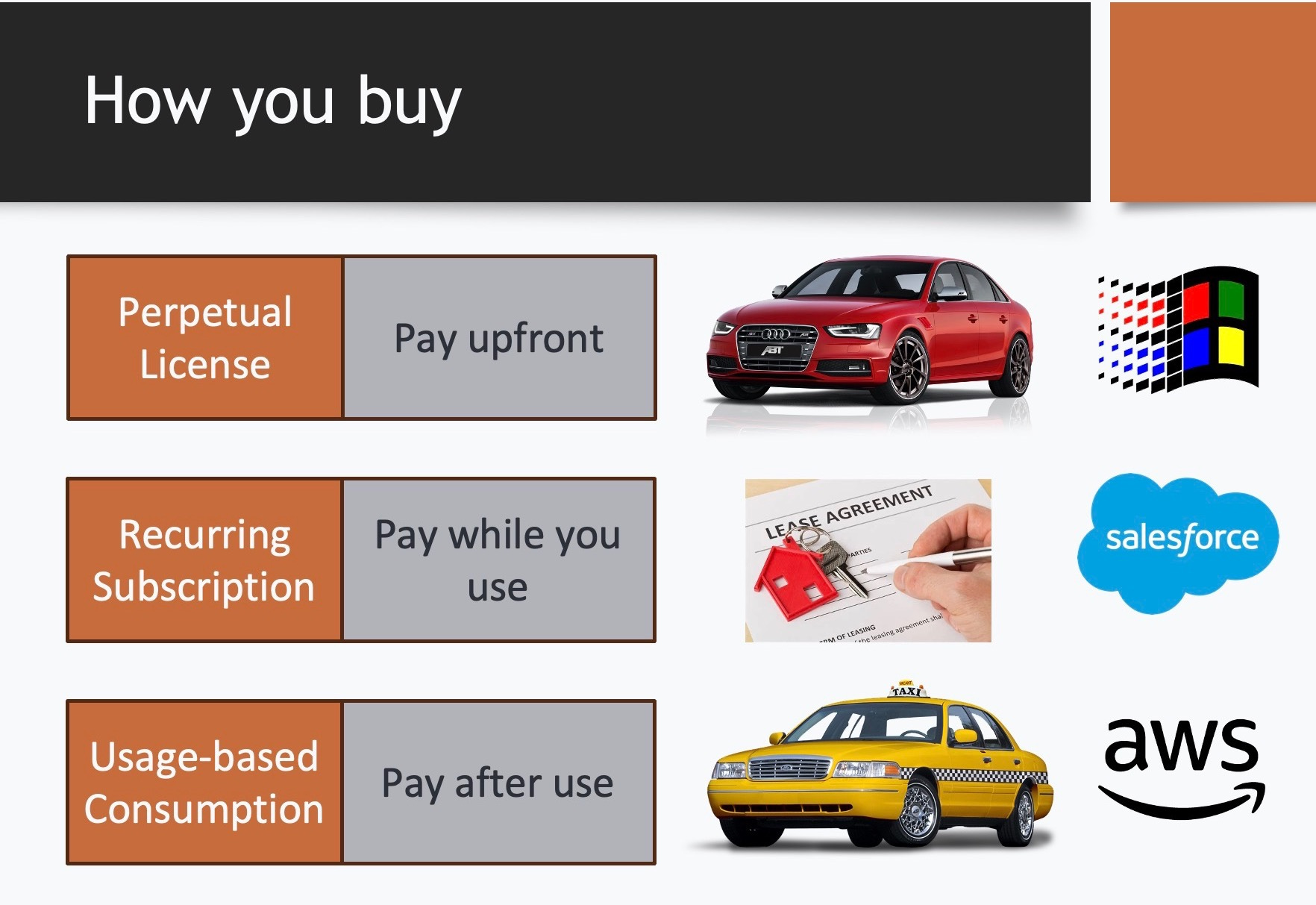
Perpetual software licenses: When PCs became mainstream with Windows 95, you had to buy a license up front. That license allowed you to use the software in perpetuity on your computer.
SaaS from 1999 onwards changed the game by moving from a one-time payment to charging an ongoing subscription. Salesforce and others turned ownership into access, exchanging upfront capital for recurring predictability.
Cloud infrastructure in 2006 went further and charged actual usage like AWS compute by second, not by seat, and billed after the customer used it.
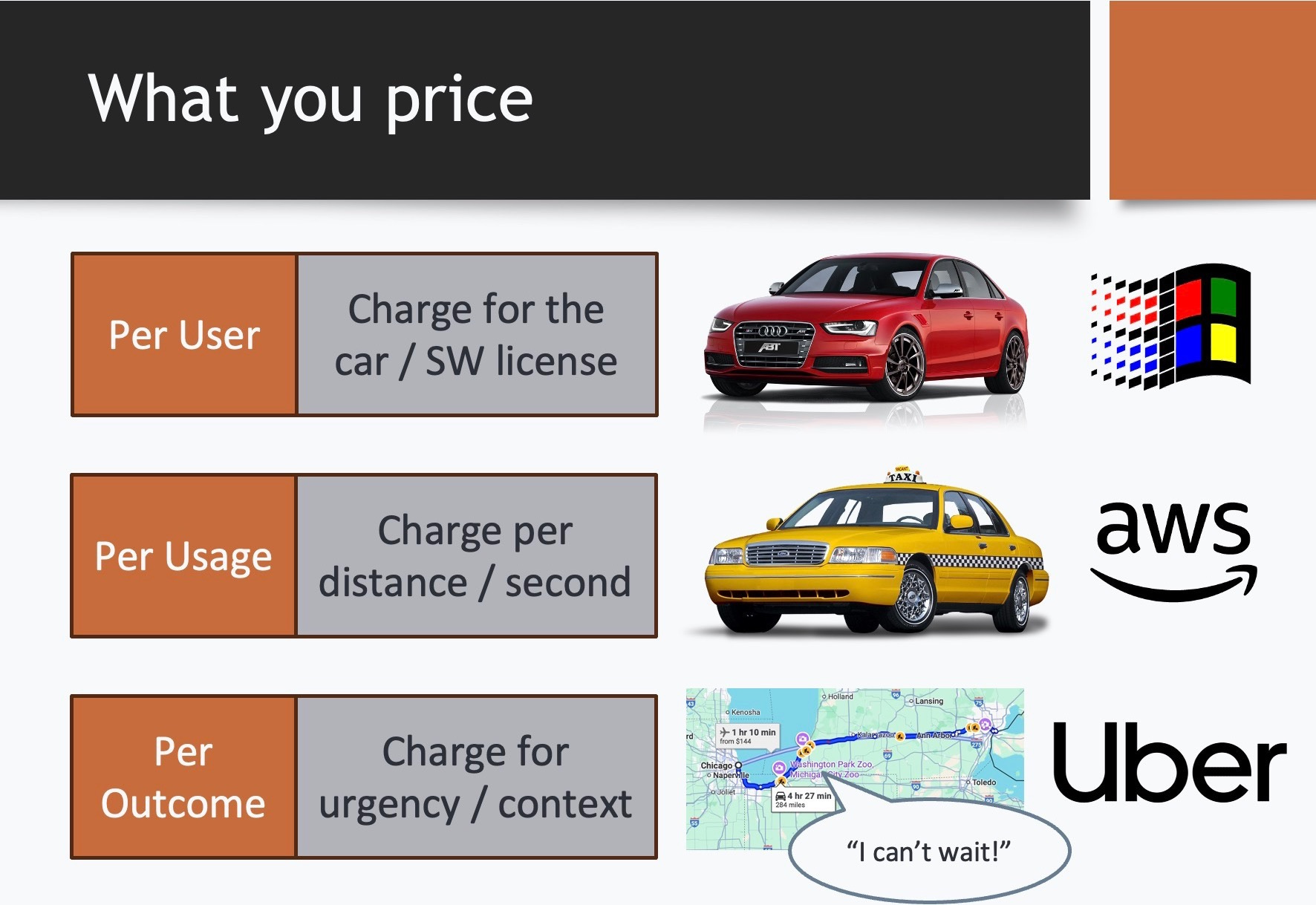
Platforms from 2010 onwards began charging for urgency and context. An Uber ride could cost more or less depending on how long you would be willing to wait. People willing to pay extra to fast-track, would pay more.
AI platforms now experiment with outcome-based billing, credits tied to tokens, task completions, edited images … and a number of other price metrics.
If you zoom out, every major tech model can be plotted along two axes: how customers buy and what companies price.
2. How You Buy vs. What You Price
Think of it as two different systems running in parallel:
Billing defines when cash moves, and impacts cash flow, not the P&L.
Pricing defines what you charge for.
Let’s look at each of them separately, and the levers you can pull to improve cash flow AND value capture.
3. Billing as a Cash Flow Lever
Billing is the engine behind your operating cash flow. It determines how quickly you turn booked revenue into usable capital.
If you compare the main contracting patterns:
Perpetual: Cash arrives before delivery. You recognize revenue over time but already hold the cash.
Recurring: You collect cash while delivering service. The balance between billing cadence and contract term determines how smooth your cash cycle is.
Usage-based (sometimes also called Consumption-based): You deliver first and bill later. Cash follows consumption, which can lag by months.
These aren’t accounting details. They define your ability to invest and grow. And there are a number of levers you can pull to optimize capital efficiency:
Contract Period: Consider extending contracts from one to three years, and you lock in predictable RPO. You may even reduce churn with fewer renewals. Some of your customers may even prefer the predictability.
Billing Cadence: Move from monthly to annual billing and you improve working capital (as long as you bill up front). Most SaaS companies offer an annual payment discount, but some skip monthly billing altogether - see case below.
Billing Timing: Bill up front! I can’t say this enough in the current AI environment. You can totally charge for usage (price metric), but have the pay for the committed volume up front (billing model).
Payment Terms: Move from Net-60 to Net-30 and free up one full month of operating cashflow. Or require payments by credit card for smaller amounts.
A three-year contract billed annually up-front means you have working capital to fund operations and invest in growth. It also gives you predictability (RPO), which investors value highly. The same deal billed monthly delays cash by up to eleven months. None of this changes ARR or your P&L, but the effects compound on your cash flow statement and can hinder your ability to invest and grow.
The best operators obsess over billing structure as much as pricing design. You can grow cash faster without touching your price model or price point by simply changing how you collect. Let’s look at two brief case studies:
Case: PagerDuty
PagerDuty is a perfect example of how billing terms design drives efficiency:
Contract and invoice annually
Collect in advance of delivering the service, and
Fees are due within 30 days from invoice date (net-30)
Payments are non-cancellable and non-refundable
The result is strong operating cash flow even in low-growth periods. Over the last two years they increased their cash position by 10+x:
Revenue grew from $371M in FY23 to $468M in FY25, a CAGR of ~12%
Operating cash flow jumped from $17M to $180M, a CAGR of ~225+%!
The quote from their SEC filing says it all: “Our cash flows from operations are primarily derived from the unearned portion of customer billings.”
Billing mechanics, not pricing, funded that growth.
Case: Atlassian
Atlassian offers Enterprise customers of Jira and Confluence only annual billing, while they let smaller companies pay monthly. When it comes to Payment terms, they are strictest with the small companies though:
Net-30 only for purchases $50k+, and only after “a one-time credit check”
Net-14 for purchases between $1k and $50k
Orders less than $1k must be paid up front
By enforcing annual up-front commitments for large deals, and strict payment terms for smaller ones, Atlassian locks in predictability and optimizes monthly cash meticulously. This led to impressive growth in cashflow (as well as revenue):
Revenue grew from $2.9B in FY23 to $4.9B in FY25, a CAGR of ~30%
Operating cash flow grew from $868M to $1,460, also ~30% CAGR
Stock price grew from $169 at FY23 start to $207 FY25 end, ~11% CAGR
These two companies prove that billing isn’t a back-office function. It boosts RPO and operating cash flow, which in turn boosts valuation multiples / stock prices. In a market where AI usage is unpredictable, that level of billing discipline gives them a structural advantage, a billing moat.
4. Pricing as a Value Capture Lever
Pricing is about measuring and monetizing value.
While billing determines when you collect, pricing defines what you count.
If you compare the type of metrics companies use to price products, you can generally group them in 3 categories:
Per User: Microsoft and Salesforce both charge per user
Per Usage: AWS charges EC3 by time used, Gemini AI top up credit packs are units that can be used fungibly for their Whisk and Flow products
Per Outcome: Uber introduced surge pricing where value is based on urgency and context, ZenDesk charges its AI agent per Automated Resolution
From a value-based pricing perspective, you always want to use the price metric that best balances these 5 criteria:
Tracks with Difference in Value Across Segments
Tracks with Differences in Cost-to-Serve
Is Easy to Measure and Enforce
Facilitates Favorable Positioning Versus Competition
Aligns with How Buyers Experience Value in Use
Those criteria are not new or even from me. They’re from Nagle & Mueller’s book “The Strategy and Tactics of Pricing”.
In SaaS, the dominant model was (and still is) a price per seat and a Good-Better-Best packaging to create an upsell extension path.
That’s changed with AI. Token counts resemble usage metrics to align with cost. The challenge with usage-based pricing is that customers pay more when the AI isn’t giving a good response right away. It misaligns incentives when you pay more for having to try a prompt 20 times to get to the outcome you want.
The real opportunity lies in pricing higher for better effectiveness. A model that completes a task accurately on the first attempt is worth more than one that needs many iterations. That’s the bridge between usage-based and outcome-based pricing. But there are challenges to address like attributability and measurability.
Your pricing determines how much of the value you create you capture. The further you move towards an outcome-based price metric, the more confidence a customer can have that they only pay for what they want.
5. The Combined Framework
When you map billing and pricing as a 3x3 matrix, you see most combinations of the billing models & price metrics are indeed used in today’s world, though some are less common than others (e.g. per user pricing with usage-based billing).
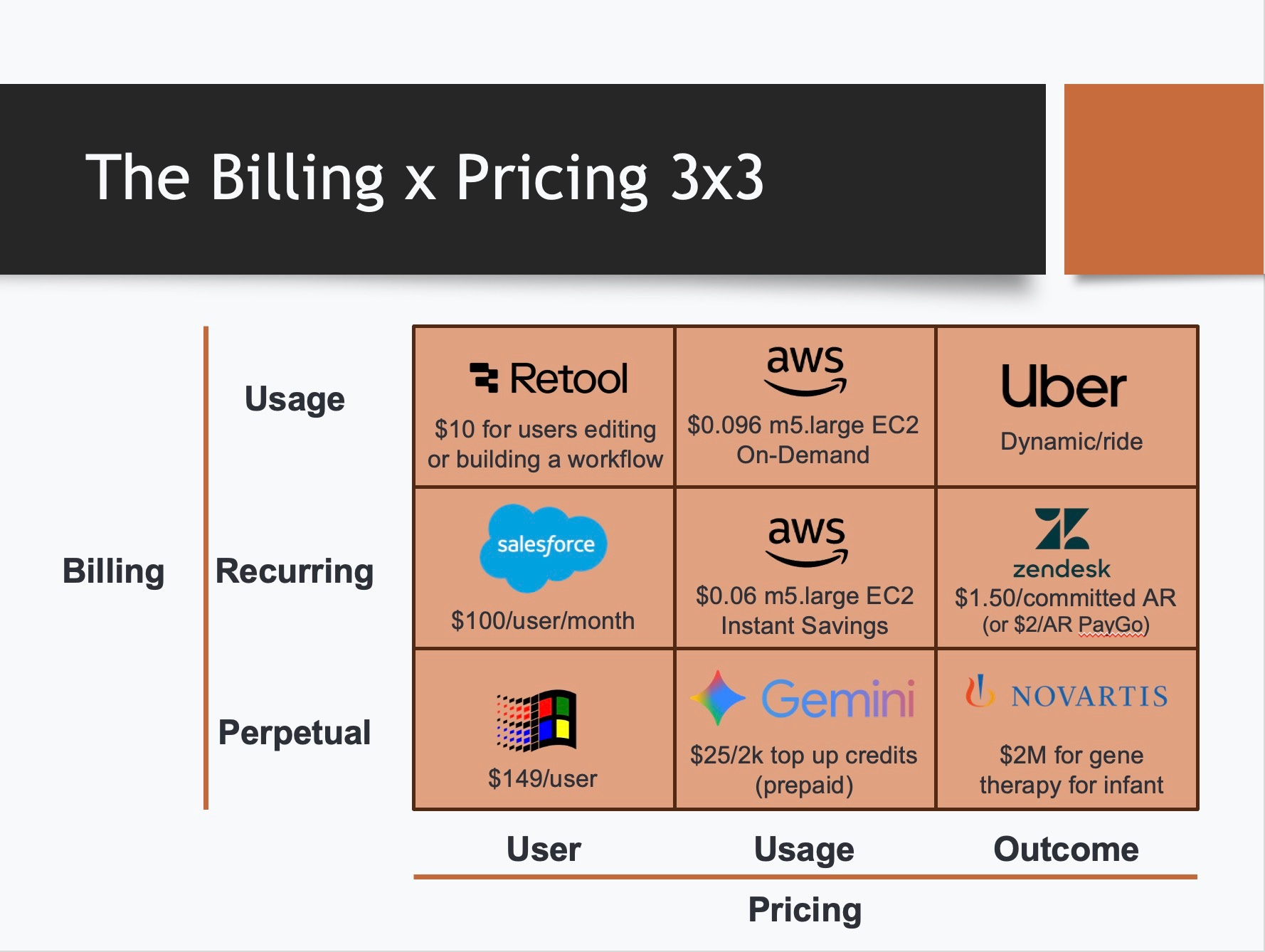
Salesforce changed how customers paid, not what they paid for. AWS changed both, from per-user to per-usage and from prepaid to postpaid. AI blurs the boundaries with some charging recurring for outcomes (Zendesk) and others allowing one-time purchase of credit packs (Gemini).
I hope this framework will help you navigate these volatile times in AI pricing strategy.
Closing Thought
Billing fuels growth through cash discipline. Customers and investors value predictability. Recurring contracts with upfront cash collection reduce risk, fund innovation, and signal maturity. That way billing can become your moat in AI monetization.
Pricing fuels profitability through value capture. Focus on defining the right price metric before fine-tuning the price level. Changing the metric requires more effort than a price increase. Choose the right price metric early that aligns with value in your customer’s eyes, and you usually have a winner.
Use this framework to dissect billing from pricing and steer pricing discussions into what matters: predictable profit that optimizes value capture and operating cash flow.