

Companies are shifting from growth-at-all-costs to profitable growth. That shift requires changing how we incentivize teams. The SaaS model rewarded volume: close more ARR, expand more accounts, ship more features. At lower margins, AI-fueled growth requires you to ensure growth is durable and profitable.
Each team needs incentives that reward revenue quality, retention discipline, value realization and focus. So how do you set these incentives for your teams?
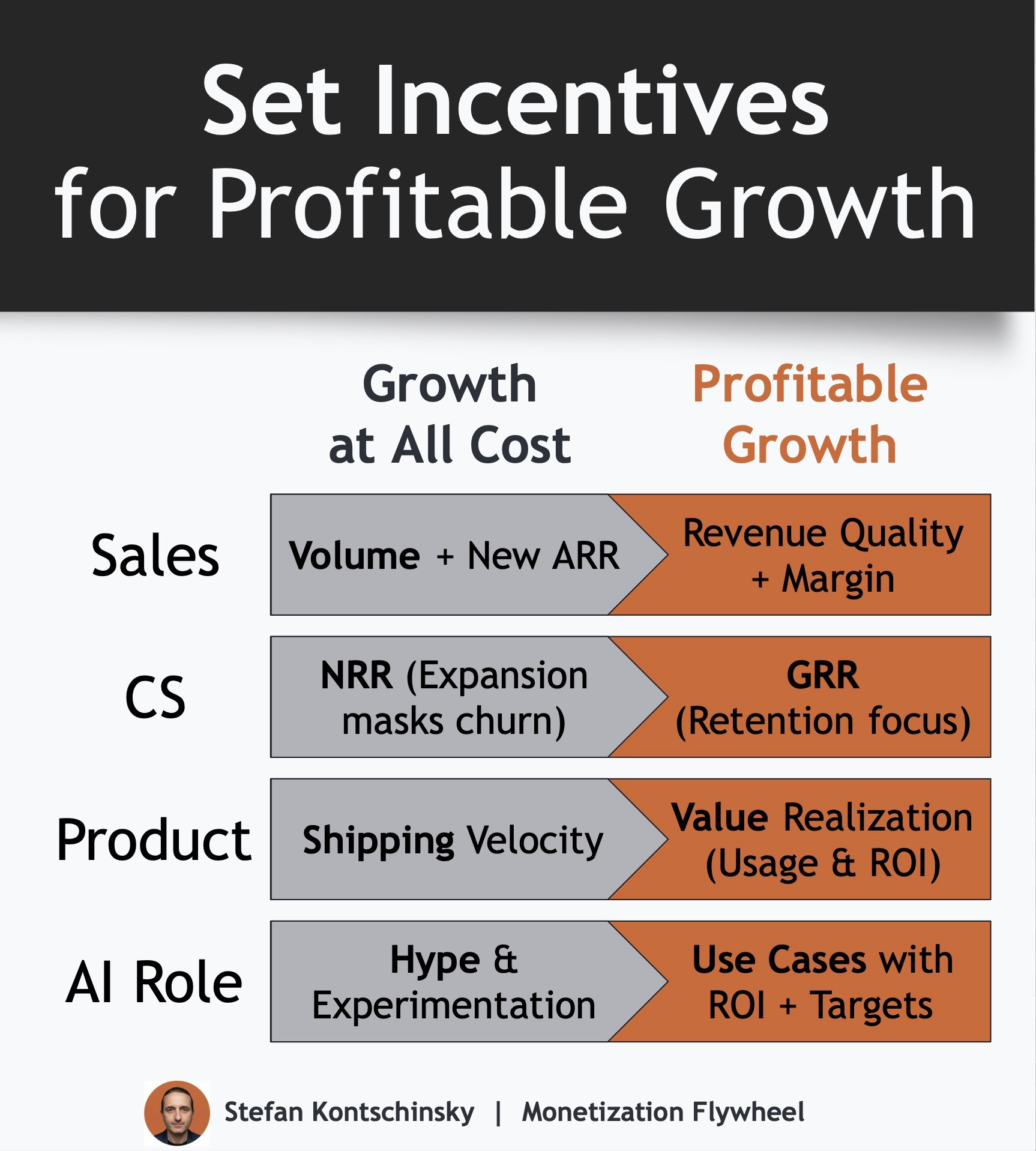
Sales: Prioritize quality revenue, not just more ARR
Most sales incentive plans still overweight one metric: new ARR.
That is simple to manage, but it misses an important point: not all revenue is equally valuable. A deal closed with heavy discounting or poor pricing discipline may help bookings while hurting long-term economics.
BCG argues that pricing metrics should be part of Sales Incentive Plans (SIPs), yet fewer than 10% of SIPs actually include any price-based metrics. That means 90+% still focus on New ARR with no indicator of revenue quality.
Two better metrics you should consider:
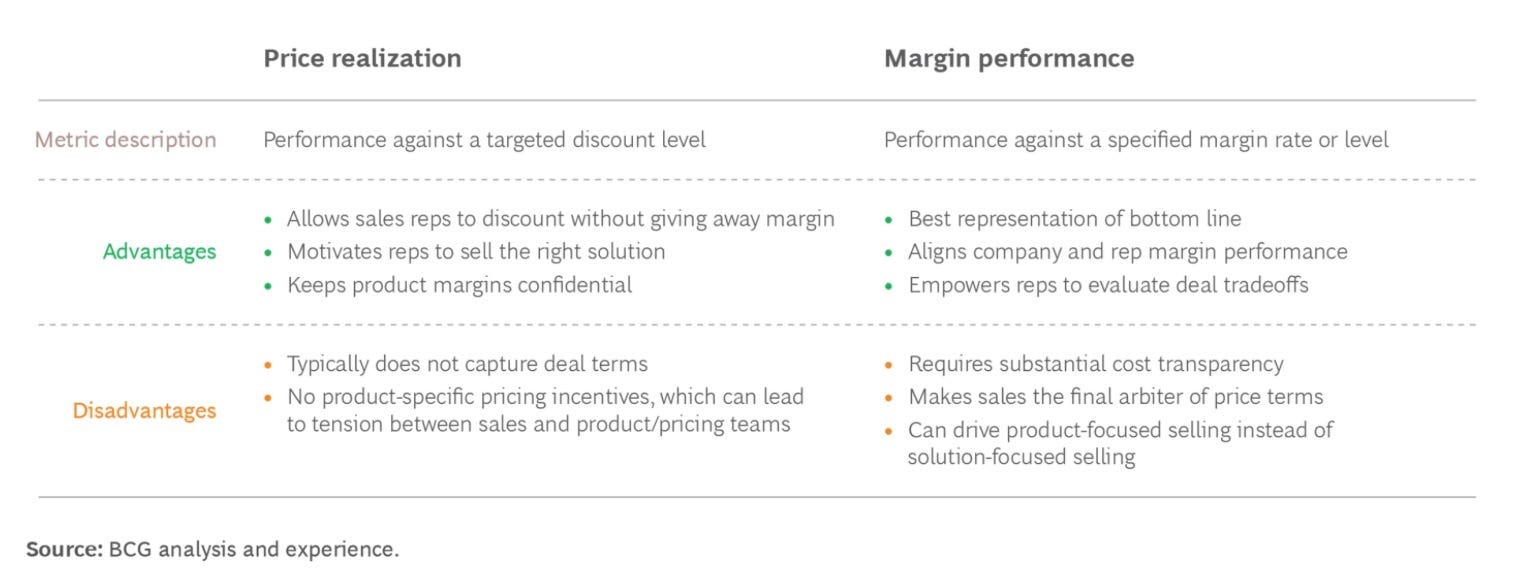
Price realization measures how well reps hold price versus list or target price.
Pro: keeps product cost and margin confidential
Con: does not directly steer portfolio mix or favor higher margin products
Margin performance measures the profitability of what is sold.
Pro: directly connects rep behavior to the company bottom line
Con: exposes margin and cost data broadly, which may change over time
Rep performance can also be evaluated in different ways:
Absolute performance
Improvement over time
Hybrid model combining both
If you want more profitable growth, don’t pay Sales as if every dollar of ARR is equally good. Set targets that align with your strategy and consider price realization or margin performance targets. For most companies, price realization is the easier starting point because it improves discipline without exposing sensitive margin data.
Customer Success: Separate retention from expansion
The same logic applies after the initial sale. For years, many CS teams were measured primarily on NRR, which combines retention and expansion into one number.
Move from NRR to GRR to isolate retention
That worked well in an era when expansion was abundant and growth the overriding goal. The TSIA State of Customer Growth and Renewal 2025 reports that
“The days of unchecked expansion have been replaced by a strategic focus on profitability, forcing companies to rethink how they allocate resources, manage renewals, and drive expansion.”
And GainSight’s Customer Success Index 2025 shows that companies are separating those motions and putting more emphasis on GRR:
62% of CS orgs use GRR as their primary metric (up from 45% 2 years ago)
CS orgs using NRR as their primary metric declined from 59% to 51%
NRR = (Starting MRR + Expansion MRR - Churned MRR) ÷ Starting MRR
GRR = (Starting MRR - Churned MRR) ÷ Starting MRR × 100
NRR is still valuable, but it can mask underlying retention problems when expansion is strong. GRR makes customer health and renewal performance easier to see. It answers a more disciplined question: are we keeping the revenue we already earned?
Companies are adopting a more disciplined approach to financial management, moving beyond rapid expansion to focus on sustainable, long-term gains.
Companies centralize renewal ownership in CS
Once companies separate retention from expansion, the operating model usually changes too. Renewal ownership becomes more specialized, and companies start asking whether expensive AE capacity should be used for every renewal motion.
They centralize renewal ownership within Customer Success rather than leaving it with higher-cost AEs. According to TSIA, shifting renewal and upsell responsibilities from AEs to specialized CS renewal teams can lead to:
~2/3rds lower renewal costs
10% higher net renewal rates
Nearly 10% higher attached upsells
AI reinforces the efficiency play
AI adoption in CS reflects the same shift toward productivity and disciplined growth. The highest adoption use cases of AI in CS focus on efficiency:
Auto summarization (82%)
Drafting email/follow-ups (71%)
Sentiment analysis (54%)
Churn or risk prediction (39%)
Next best action recommendations (30%)
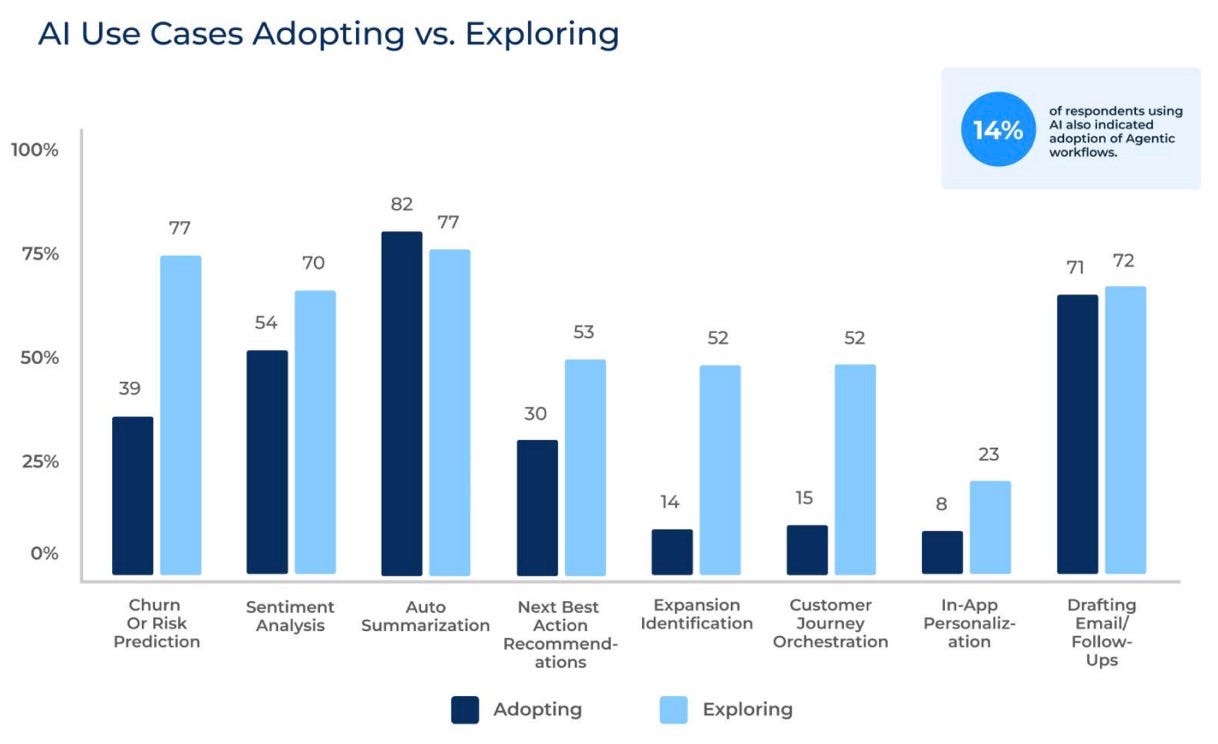
These are not “AI for AI’s sake” use cases. AI is being adopted first where it can reduce manual work, improve consistency, and help teams manage retention at scale.
The incentive lesson is that CS teams should not be rewarded only for coverage or activity. You should reward them for scalable retention outcomes: lower renewal cost, faster risk identification, and better GRR.
Product: Value creation trumps feature velocity
Product teams used to be rewarded for shipping: roadmap delivery, launch volume, and shipping velocity.
In the AI era, incentives for Product teams need to shift to reward adoption, usage, retention, expansion and creating value to increase willingness to pay. There is a large gap between what teams build vs. what customers actually use.
For every 100 features you’ve built and launched, 6.4 of them are driving 80% of click volume. For best-in-class products, feature adoption jumps up to 15.6%.
Source: Pendo’s benchmark report
The Product-Led Alliance’s The State of Product Analytics Report 2025 shows a similar shift towards value realization:
Customer feedback is increasingly used to decide on new features (44% → 49%)
Retention has overtaken revenue as the #1 goal for analytics programs
Role of AI: Define use cases with ROI & set targets
The same principle applies to AI investment. McKinsey’s State of AI in 2025 found that while 88% of companies use AI, only 6% get 5+% EBIT impact. “AI high performers” are more disciplined. They set growth and/or innovation as an objective of AI efforts, define use cases, redesign workflows and align leadership.
They follow 10 best practices across 4 areas:
Use cases and leadership alignment on value:
- Have defined a road map with specific AI initiatives and use cases across priority business domains, aligned with broader AI strategy
- Top leaders understand how AI can create value for the business
Rapid iteration:
- Have an agile product delivery organization or an enterprise-wide agile organization with well-defined agile team delivery processes
- Have an established process for building AI solutions and iteratively improving them (eg, guardrails, approach to development)
- AI efforts process quickly and are adaptive (ie, characterized by quick decision-making and iterative learning
Require Processes and role model:
- Embeds AI solutions into business processes effectively (eg, changing frontline employees’ processes, creating users interfaces)
- Senior leaders are actively engaged in driving AI adoption, including role modeling the use of AI
- Have developed a clear workforce plan (for technology and nontechnology roles) that incorporates the anticipated changes from AI
Frontier tech with human in the loop:
- Technology infrastructure and architecture allow implementation of core AI initiatives using the latest technologies
- Have defined processed to determine how and when model model outputs need human validation to ensure accuracy
Scaling agents are downstream of process redesign. High performers are almost 3x as likely to fundamentally redesign workflows and push for transformative change. They also scale use of agents 3x faster though, and get >5% EBIT impact.
The overall lesson
Incentives drive behavior. Behavior shapes the quality of your growth.
If you pay Sales only on new ARR, you incentivize discounting.
If you measure CS on NRR, early signs of churn can get masked.
If you manage Product by velocity, you incentivize features regardless of value.
If you experiment with AI without clear use cases, you are not going to see returns.
Profitable growth requires that you set incentives that reflect your goals.
Reward Sales for acquiring high-quality revenue.
Reward CS for protecting existing revenue.
Reward Product for prioritizing value creation.
Focus AI investments on measurable use cases with clear ROI.
Then your incentive system rewards profitable growth.
There is a lot of great content to digest here. I'd love to hear more about GRR vs NRR. And of course, love "Value creation trumps feature velocity"! Amen to that!