

I made this price waterfall with the components that are common in B2B SaaS and AI pricing, as a simple Google Sheets template to save you time presenting yours.
This builds on the classic price waterfall from Managing Price, Gaining Profit, which showed how companies leak revenue from list price, invoice price, to pocket price. It’s a classic and useful, but with AI we need to consider variable costs.
For years, the standard SaaS price waterfall was:
List price → discounts → net price:
Pricing Teams were focused on determining the list price and questioning standard discounts and sales concessions. But with AI, one more step is critical:
Net price → variable cost → contribution margin:
A customer can look attractive at the net price level and still be margin dilutive once you account for AI inference.
The AI Price Waterfall
The AI price waterfall puts variable cost in perspective to the discounts sales is already used to from B2B SaaS and AI pricing.
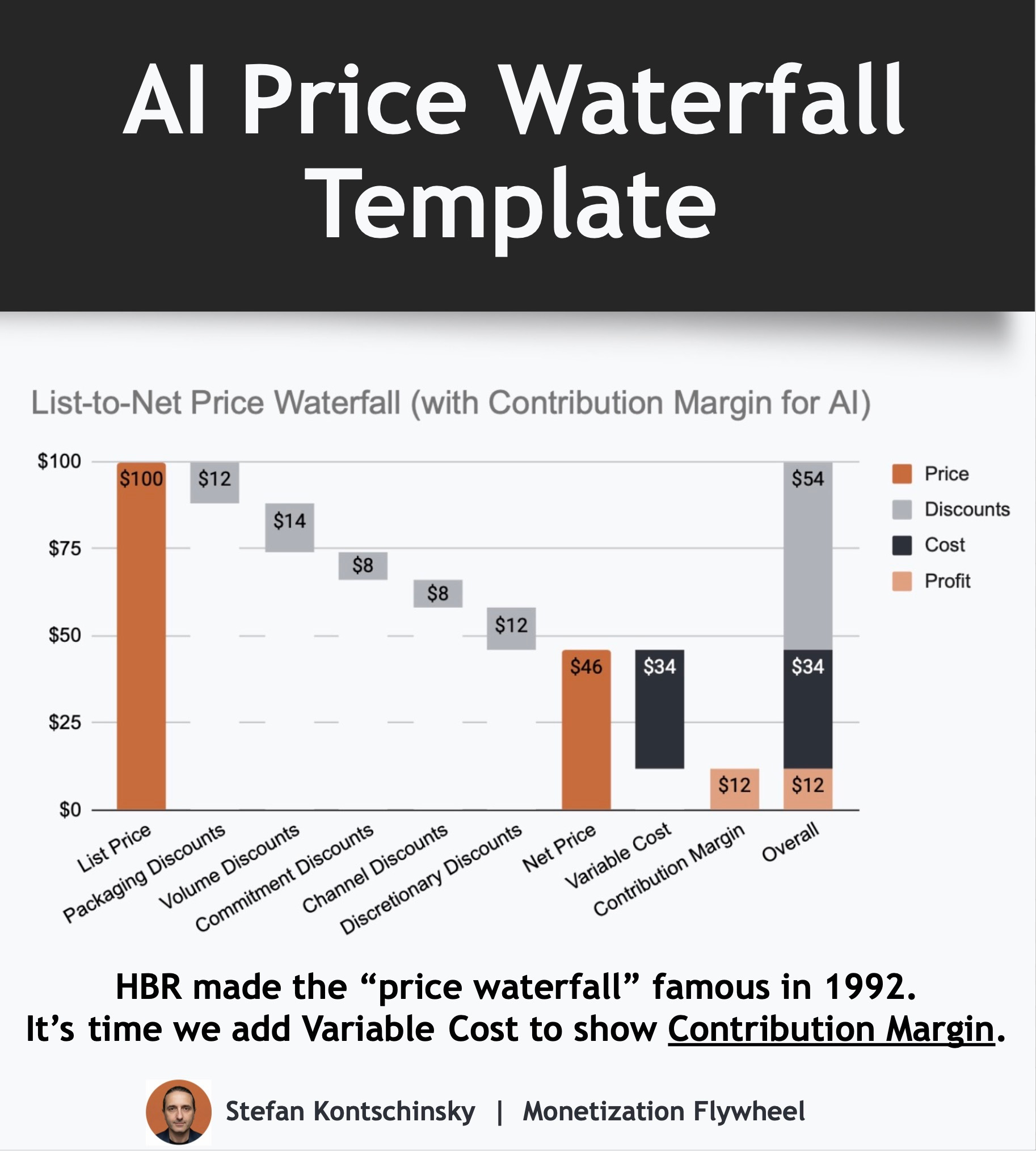
List Price: The standard published price before any discounts, concessions, fees, or customer-specific adjustments are applied.
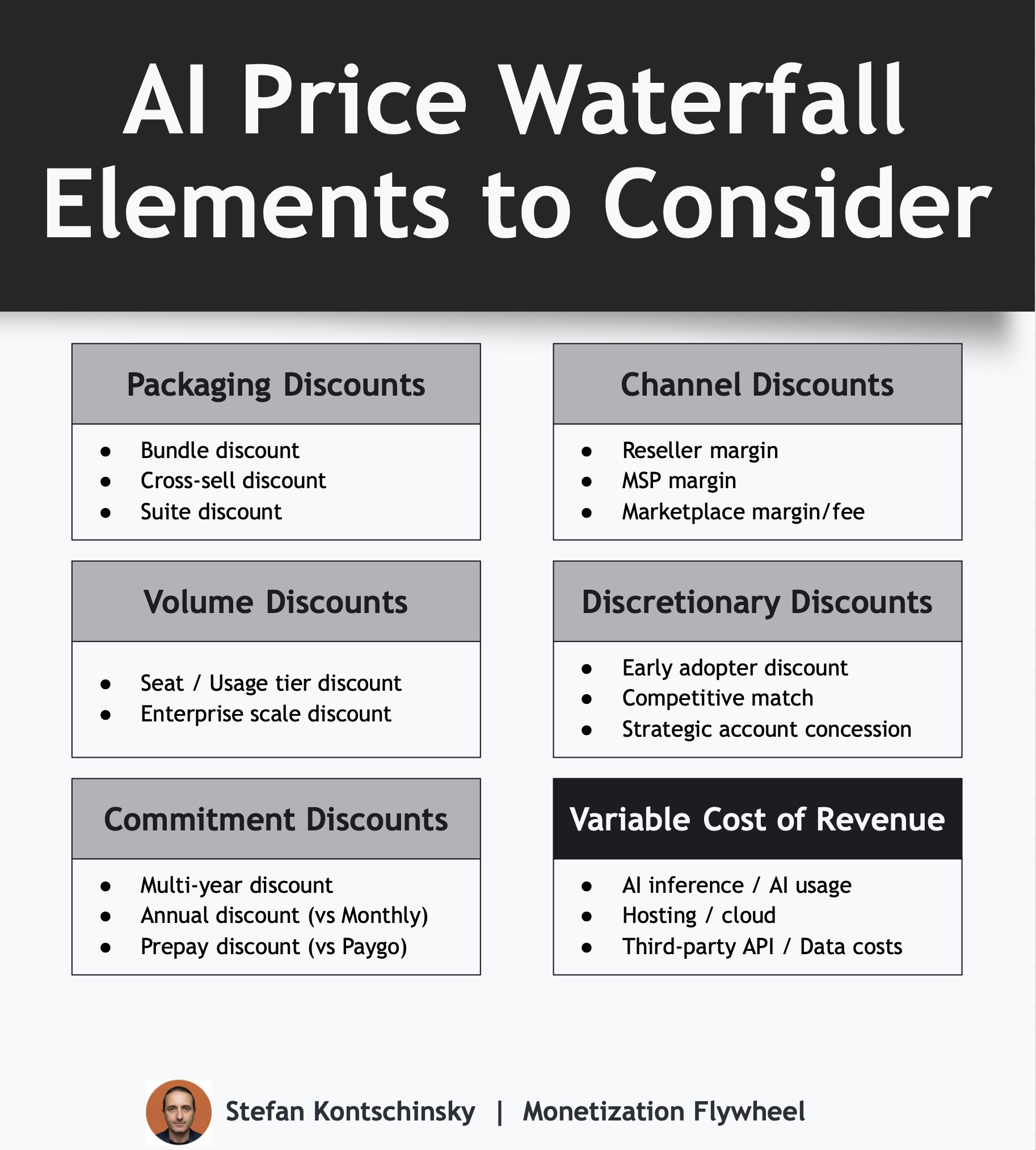
Packaging Discounts increase product adoption or deal size by incentivizing customers to buy multiple products, modules, bundles, or the full suite together.
Volume Discounts reduce the effective unit price as customers commit to higher seat counts, usage levels, transaction volumes, or enterprise-scale deployments.
Commitment (Billing & Contracting) Discounts incentivize longer contract terms, annual billing, or prepayment upfront. This article is a deep dive on these.
Channel Discounts (or fees) compensate intermediaries such as resellers, MSPs, or marketplaces for selling, managing, or distributing your product.
Discretionary Discounts extend deal-specific discounts selectively to win early adopters, match competitors, or secure strategically important accounts.
= Net Price: The actual realized customer price after all discounts, credits, rebates, channel margins, and negotiated concessions.
Variable Cost of Revenue are the variable costs to deliver your product such as AI inference / usage, cloud hosting, third-party APIs, or data acquisition and processing.
= Contribution Margin: The revenue remaining after subtracting variable cost of revenue, used to assess deal profitability and discount headroom.
Why This Matters More for AI
Notice the waterfall does not stop at the net price. It continues through variable cost of revenue and ends at contribution margin.
Traditional SaaS companies ignored that step, because variable costs were generally low. They had high gross margins and relatively predictable cost to serve. That made list price determination and discount management the two main pricing problems.
AI changed that. Two customers paying the same net price can generate very different margins. One customer is a light user with predictable workflows. Another runs high-volume inference, relies on expensive frontier models, and triggers APIs often. If both customers get the same discount, they look similar in ARR but very different in contribution margin. Your pricing strategy needs to account for that, or you end up subsidizing your heaviest users that get the most value.
A better waterfall shows where price is being given away and where margin is being eroded. Net price is no longer the finish line. For AI products, it is the midpoint. The waterfall helps pricing teams see whether a pricing strategy works after discounts AND usage costs.
Waterfall Template for Google Sheets
I made you a simple Google Sheets template for this: the list-to-net price waterfall template. It has two tabs: one with instructions, the other with the waterfall.
Make a copy and use it as you wish. Use it to compare customer segments, align your leadership on which discounts are creating value versus eroding margin, or to simply compare deals. My goal is to make it easier for you to do your job and show:
List price → discounts → net price → variable cost → contribution margin
If you share it, please just be so kind and mention where you got it from. 🙂