

Many SaaS and AI companies destroy margins through undisciplined discounting. Every deal gets negotiated and custom discounted. In SaaS, discounting was relatively forgiving because costs were largely fixed. Generative AI breaks that: your cost scales with usage, the wrong discount can turn a promising AI product into a margin trap.
This post gives you a structured way to evaluate discounts so they protect value instead of eroding it. You’ll get:
A clean taxonomy of discount types and when to use them + real examples
A quantitative test for whether a discount creates or destroys profit
A practical playbook to align discounting with your growth strategy
1) The Three Types of Discounts: Billing & Contracting, Lifecycle and Segment
Billing & Contracting Discounts
Annual prepayment discounts:
Exchange flexibility for predictability. The customer commits for a year and prepays. You get better cash flow, lower churn risk, and higher forecast accuracy.
Examples: Lovable Business costs $42 per user per month with annual billing or $50 as monthly, Cursor Teams is $32 with annual billing, or $40 monthly. A 16-20% annual discount in exchange for annual up-front billing is common in SaaS as well as in AI.
Multi-year commitment discounts:
Trade flexibility for longer term revenue durability (RPO) and planning certainty, while payments remain monthly or annually. In AI and cloud, commitment-based discounting is the shift from on-demand usage to committed-use savings plans.
Examples: Microsoft Azure and AWS Compute Instant “Savings Plans” offer 60+% off when for committing to a steady amount of compute spend per hour over 3 years.
Product Lifecycle Discounts
Early adopter discounts:
Reward customers who adopt new capabilities before they are fully mature. That might be an explicit “preview” price or a lower introductory price that increases once the product stabilizes.
Example: Jamesserra.com reported that Microsoft introduced Query Acceleration for Azure Data Lake Storage at a 50% discount relative to the intended standard rate.
Multi product cross sell discounts:
Expand customers by adopting more of your platform through a temporary incentive. The economics rely on increased ARPU and deeper lock in, at the expense of margin per product for a time.
Example: HubSpot Starter Customer Platform bundle is “The Starter edition of each product” and instead of discounting individual Hubs permanently limited to “up to 40% off HubSpot’s Starter Customer Platform for the first year”.
Legacy migration discounts or credits
Ease the transition from legacy products to new ones to simplify the portfolio. This accelerates the adoption of modern architectures and avoids relying solely on “end of life” phase-out.
Example: Atlassian cloud transformation incentives help migrate customers from Data Center or self-managed environments to Atlassian Cloud. These include credits for unused maintenance contracts and dual licensing periods.
Segment Discounts
Segment discounts are deliberate pricing policies for specific customer groups, not one off negotiation levers. They can be extremely aggressive without eroding your enterprise reference price if you keep the segmentation crisp.
Education and student discounts
Fuel adoption in the education segment, so students are familiar with the toolset when they start the workforce - and drive or even demand adoption of the tools they know in the workplace.
Example: Adobe Creative Cloud Pro for students and teachers offers Photoshop, Illustrator and Premiere to students and teachers at a 70% discount for 1 year on Cyber Monday.
Startup discounts
Support early-state companies with limited budgets but high growth potential, and count on your product being sticky. The discount is really a customer acquisition and ecosystem play for future, higher value usage.
Example: Notion for Startups offers eligible startups up to six months free on the Business plan with Notion AI included.
Non profit discounts
Subsidize socially desirable customers, who tend to be very price-sensitive due to limited funds.
Examples: Google offers Workspace for Nonprofits for $0, and discounts Business and Standard offerings by 70+% vs standard pricing. Microsoft 365 Nonprofits offers 75% off for E3 and 60% for E5 licenses compared to commercial licenses.
Military discounts
Salute service members and ease their transition into the commercial sector, but with strict limits such as one license only to avoid abuse and resale.
Example: Adobe Veterans Advantage provides a 15% discount on Creative Cloud Pro for eligible military members and veterans through programs like Veterans Advantage
Frontline worker discounts
Many B2B tools are built for desktop users, and require a monitor to unlock their full value. Workers on shop floors, in hospital rooms or emergency response vehicles may get less value and demand a cheaper option.
Example: Microsoft 365 Frontline Workers F3 license is $8 per user per month (76% less than an E3), marketed as purpose-built (some apps are not included) and limited to “employees whose primary responsibilities involve direct interaction with customers, patients, or the public, or who support essential services.” This effectively fences the lower priced package.
2) Effective Discounting Requires Math and Clarity
Breakeven Sales Depend on the Contribution Margin
Every discount cuts your unit margin. To increase the bottom line, you need enough incremental volume to offset it. The key parameter is contribution margin: revenue minus variable costs as a percentage of revenue.
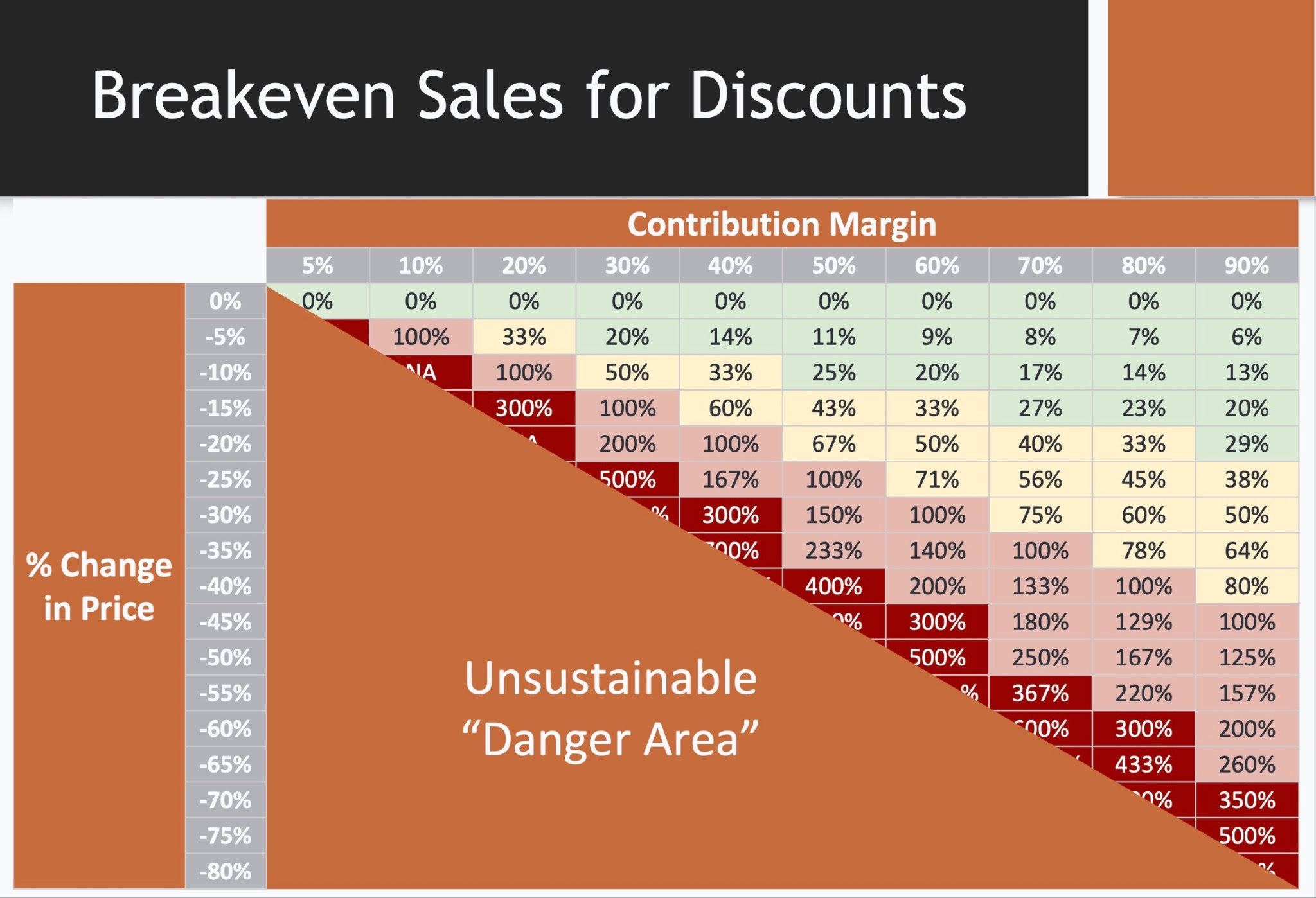
If your contribution margin is 80% and you discount 10%, you need a 14% increase in volume to get to the same profit, the “breakeven sales”
If your contribution margin is only 20%, cutting prices by 10% is very different. Variable costs take up most of the revenue already. A seemingly small discount wipes out most profit, and you’d need to double volumes to break even.
This chart makes the “breakeven sales” tangible:
Look up your contribution margin on the x axis.
Find the price discount you’re considering on the y axis.
Find the volume uplift required to keep profit constant (it is color coded).
This gives you a quick visual check:
At low margins, even modest discounts require aggressive growth to break even.
At high margins, small, tightly controlled discounts can be economically acceptable if they drive retention, expansion, or adoption of strategic AI features.
Clarity Preserves the Reference Price Point
Customers internalize a “reference price” that they view as normal. If you discount regularly and without clear guardrails, the reference price drifts down to the discounted level. That makes full price feel inflated and invites pushback.
Clarity is your countermeasure. Treat discounts as conditional, not a default:
Conditioned on contract structure: e.g. annual pre-pay, multi year commitment
Conditioned on product lifecycle: e.g. temporary early adopter discount
Conditioned on specific segments: startups, education, nonprofits, etc.
When you draw that line clearly, you protect the integrity of your list price. Enterprise customers who do not meet the conditions pay the price without feeling that they are “missing” a perpetual sale.
3) The Practical Discounting Playbook
A disciplined discounting playbook prevents revenue teams from improvising on every deal and keeps discounts aligned with strategy and margin.
Step 1. Pick which discounts you offer, and which you don’t
Start by mapping discount types to business goals:
Billing and contracting discounts accelerate cash, reduce churn, and improve predictability.
Product lifecycle discounts drive adoption of new AI features or cloud platforms, support migration off legacy platforms.
Segment discounts deliberately grow segments that matter for brand, volume, or long term opportunity.
Decide which of these you want to use and which you explicitly do not. That clarity keeps ad hoc discount ideas from creeping in.
Step 2. Consider how discounts stack
Customers often qualify for multiple discounts at once. Like a startup nonprofit adopting a new AI add-on on a three year contract. Without guardrails, they could accumulate annual, multi year, startup, nonprofit, and early adopter discounts into something economically absurd.
You need rules:
Which discounts are mutually exclusive
Whether some categories cap the total allowed discount
Your Sales team needs to know these guardrails to grow your business effectively.
Step 3. Model scenarios to ensure profitable growth
Finally, link discounting policy back to contribution margin and breakeven volume:
Take your contribution margin by product or bundle
Overlay planned discounts and compute the required volume lift to break even
Stress test AI workloads where cost can fluctuate (e.g. tokens, API usage)
This is where usage-based AI models require more rigor than traditional seat-based SaaS. Your discount may make sense at current infrastructure prices and model efficiency, but break down if customers use your product in more intensive ways.
4) Final Thought
Discounting is not inherently good or bad. It’s a tool. Used well, it accelerates growth, opens doors to high growth segments, and secures profitability. Used poorly, it erodes margins, trains buyers to wait for concessions, and muddies your positioning.
The discipline is simple to state and hard to execute.
Decide why you discount.
Decide where you discount.
Decide how far you are willing to go at a given contribution margin.
If you do that work, discounting becomes part of your monetization strategy instead of a last minute lever in a desperate quarter end negotiation.