

AI changed discounting because the unit economics are different from SaaS. In AI, variable costs are real. That is why I benchmarked AI discount structures.
I touched these three levers before in my post on Discounting as a Growth Lever. This is the deeper benchmark cut focused on billing and contracting discounts.
Across the pricing pages I reviewed, billing and contracting discounts show up in three forms.
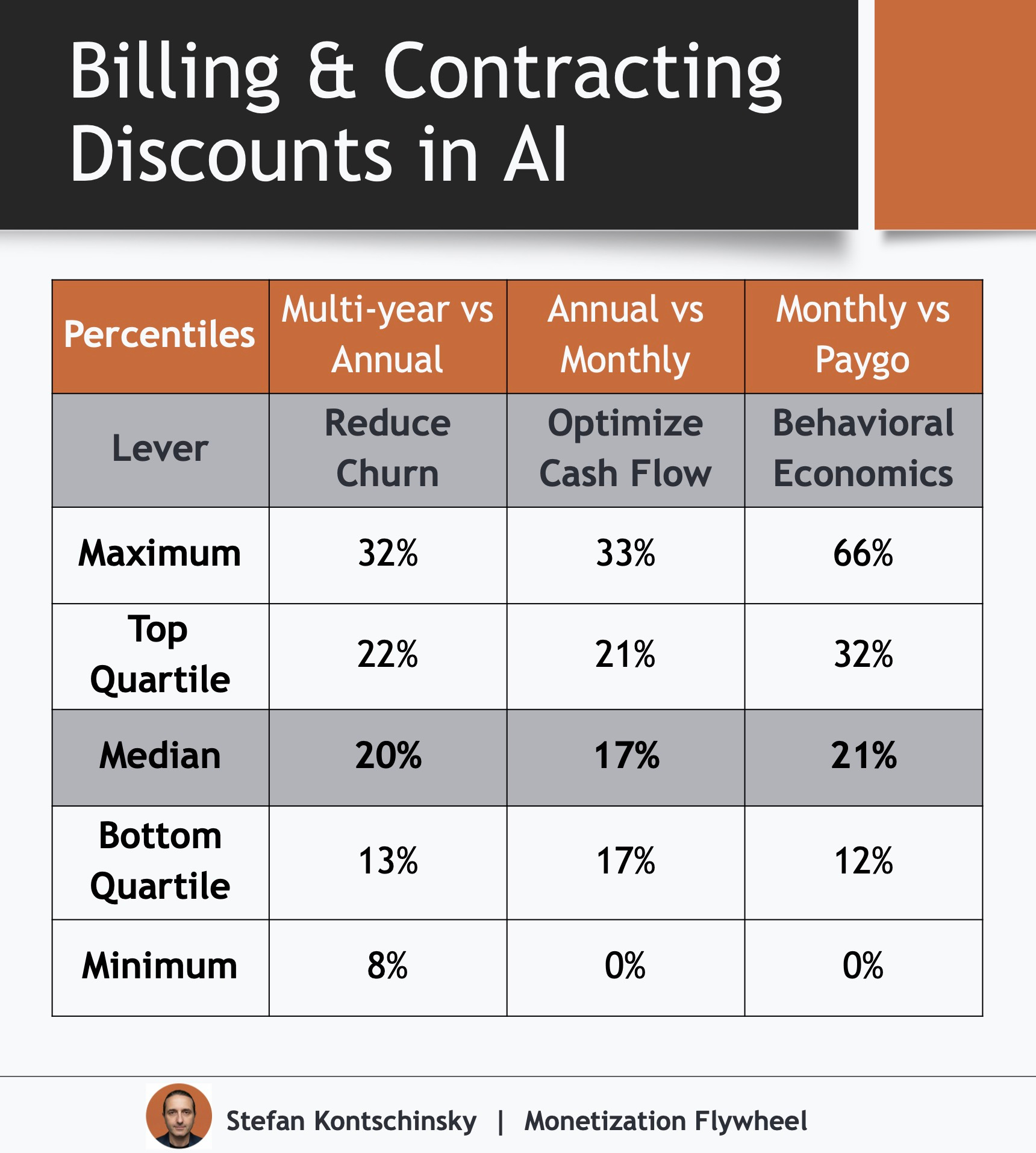
1) Multi-year vs annual: Churn reduction
Multi-year commitments are usually still paid annually. The customer typically does not prepay 3 years up front. The main benefit is churn reduction through fewer renewal moments.
A 3-year commitment means the customer questions the purchase 67% less often. Once every 3 years instead annually. A 2-year commitment still reduces the decision points by half.
One observation before the numbers. Very few B2B companies publish multi-year discounts on pricing pages. That makes the few that do publish them unusually valuable. If you work in pricing, these data points are gold.
In my dataset, the median for multi-year vs 1-year discount is 20%.
3 examples:
• Codeanywhere Premium: 13% ($23 per month on 2-year vs $20 on 1-year)
• TaxDome Pro: 10% ($900 per year on 3-year vs $1,000 on 1-year)
• SEO PowerSuite Professional: 32% ($239 per year on 3-year vs $349 on 1-year)
2) Annual vs monthly: Cash flow optimization
In most B2B products, “annual” typically means annual contracting plus annual prepayment. This is a working-capital lever as much as it is a commercial one.
Annual prepay improves cash conversion and lowers billing friction. On top of getting the cash up front, your Finance team has to issue and reconcile 92% less invoices.
In my dataset, the median discount for annual prepayment is 17%.
3 examples:
• Cursor Pro: 20% ($16 p.m. billed annually vs $20 monthly)
• Replit Core: 20% ($20 p.m. billed annually vs $25 monthly)
• GitHub Copilot Pro: 17% ($100 annually vs $10 monthly)
3) Monthly vs Paygo: Behavioral economics
Monthly subscriptions (vs annual commitments) are much less predictable and create a lot of uncertainty for AI companies like Lovable. Their Growth leader Elena Verna recently said this:
‘Velocity of Shipping’ is our #1 dev team value. And for a product like Lovable, it has to be, because Product-Market Fit is now a constantly moving target. This is because both the underlying technology (which shapes the product) and the customer expectations (which shape the market) are both changing on a monthly basis.
Elena Verna, Lovable
Monthly subscriptions (vs paygo) don’t change that, but they use the same behavioral economics pattern that makes gym memberships so successful. People overestimate future usage. Paygo forces you to feel the pain of EVERY single use. A subscription removes that friction, makes continued usage feel like a gain (since you’ve already prepaid), and charges even if you use it less.
In my dataset, the median discount here is 21%.
3 examples:
• Lovable: 17% ($25 for Pro including 100 credits vs $15 for 50 top-up credits)
• Luma AI: 20% ($20.99 for Plus including 10k credits vs $4 for 1,200 credits)
• ElevenLabs: 27% ($22 for Creator including 100k credits vs $0.30 for 1k credits)
Stacking discounts
Buyers (and you Account Executives) stack these billing and contracting discounts. Multi-year plus annual prepay plus commit instead of paygo.
Using the percentile table, the implied 3-year vs paygo discount lands at 48% at the median. Top quartile is even 58%.
Most companies don’t publicly offer all three levers, but many B2B companies already discount annual and multi-year commitments. If you layer AI credit pricing on top, make sure you understand unit economics well, and define stacking rules clearly.