

Scan AI pricing pages and labels are familiar: Free, Pro, Business, Enterprise. Despite AI’s high variable compute costs, the naming conventions look very similar to SaaS. But AI-native companies have a new middle tier, and differentiate tiers differently.
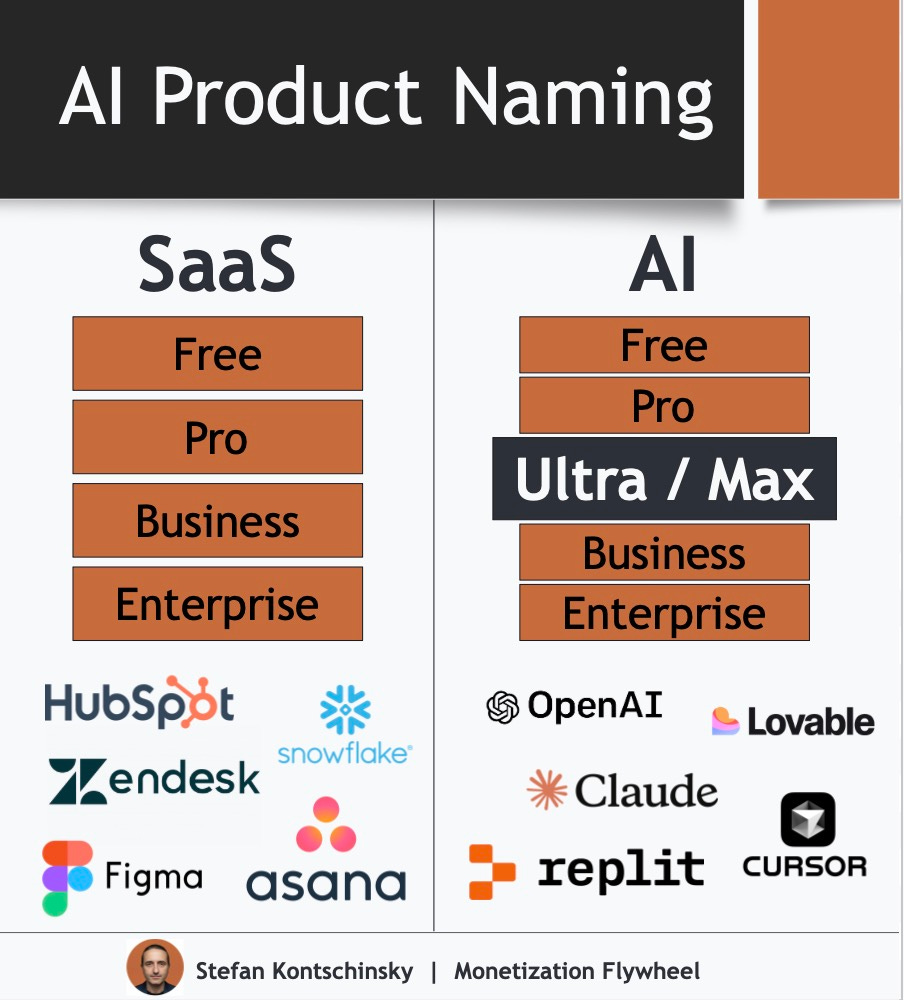
1) Naming conventions stayed similar to SaaS
Many SaaS companies had 4 tiers (with few exceptions like Salesforce having more).
“Free” or “Starter” was the entry tier for many SaaS companies. Though ”Starter” is not common for AI companies, “Free” remains the default entry tier name for more than two thirds of AI native companies such as ChatGPT Free and Claude Free.
“Pro” remains a very common name for a paid tier. In our dataset, over 80% of AI-native companies have a tier named “Pro” (e.g. Cursor Pro, Perplexity Pro).
“Business” persists as the most common name for the tier that has some limited business features. 50% of companies in our data set had a tier that contained “Business”, such as ChatGPT Business, Grok Business and n8n Business.
“Enterprise” remains the most common top tier name, e.g., Lovable Enterprise, Replit Enterprise. Companies still require SSO, admin controls, and centralized billing. It’s actually not easy to find a company that does not have an “Enterprise” tier.
2) Packaging added power user tier(s): Ultra/Max
AI-native companies also have generally an additional middle tier. This tier is aimed at power users (developers, analysts, researchers) and priced in the range of $100-$200 per month. The name varies with “Ultra” and “Max” being the most common at the moment, e.g. Cursor Ultra ($200), Claude Max 5x and Max 20x ($100 and $200).
In B2B SaaS, tiers were mainly differentiated by features and company size. “Land and Expand” sales motions often started with one team, expanding enterprise-wide later. AI adoption often starts with a few individuals experimenting too, but power users have high costs. The additional power user tier(s) capture higher prices earlier in the adoption cycle.
To maximize price capture in B2C, some AI companies also introduced a new lower-priced tier to monetize the many light users not willing to upgrade to Pro. ChatGPT Go ($8, ad-supported) promises 10x the usage of their Free plan, and Gemini AI Plus ($7.99) has twice the credits of Free. Both were launched globally in January 2026.
3) Differentiators shifted: features → usage
While in SaaS, tiers were mainly differentiated by features and company size, AI-native companies like Claude differentiate tier much more around “More usage” and “Priority access at high traffic times”. The reason is simple: AI products incur real compute costs, and power users can cause a significant cost far beyond what they pay, even with the new Ultra/Max tiers.
So usage must be controlled, and companies have two levers for this:
Throttle usage to indirectly ensure value scaling. Claude has these limits:
Session limits: A limit for each session, which resets every 5 hours.
Weekly limits: Weekly limits across all models + some model specific ones.
Meter usage directly: scale pricing with usage within a tier (often via credits), e.g.:
Replit Pro pricing has a drop down to select between $100 and $4,000 (40x)
Lovable Pro pricing allows selecting between 100 to 10k credits (100x)
Your operator takeaway
Even though AI changed the economics, the tiers naming did not radically change. AI-native companies kept what buyers were already familiar with (“Free”, “Pro”,
”Business”, “Enterprise”).
They evolved the tier structure and names to reflect their economic reality by adding one or two “Ultra” / “Max” tier(s) for power users, differentiating tiers with usage throttling, and allowing to purchase metered usage (up to 100x) within a tier.