

As AI features move from “nice to have” to core workflow, finance teams are pushing vendors toward predictable spend. Vendors push for predictable ARR. The result is a new playbook for handling overages.
Which tactics companies choose to turn volatile AI usage into more stable, recurring revenue comes down to answering two questions:
Who bears the risk? Do you shift volatility risk to the customer, or absorb it?
How do you control it? With contractual terms or in-product levers?
Drawing this as a 2x2 matrix shows four combinations, and all 4 are gaining traction:
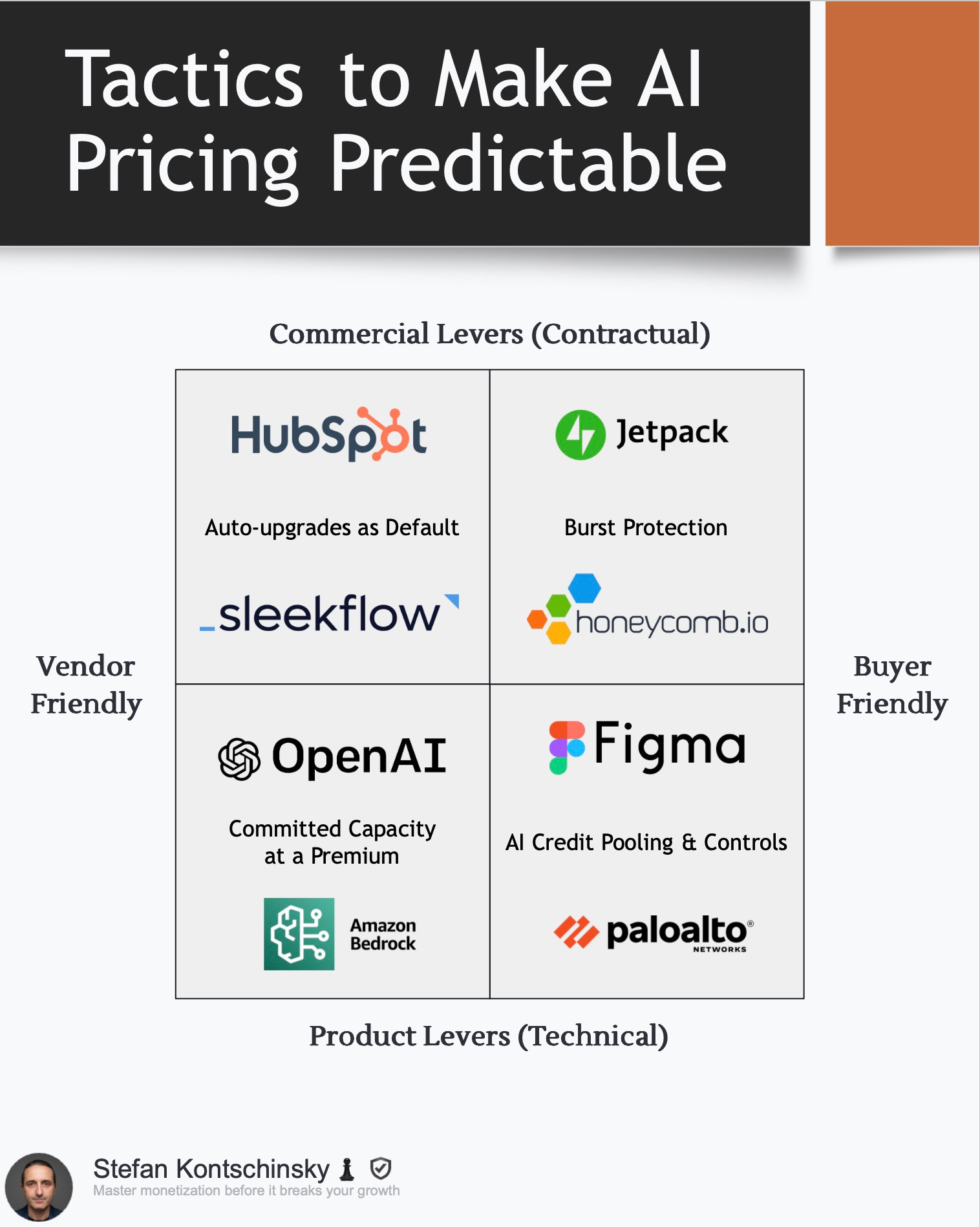
1) Committed capacity at a Premium
(vendor-friendly, commercial)
In SaaS, committed volume meant discounts. In AI, committed capacity can cost more because it comes with reserved performance.
OpenAI Scale Tier pricing offers higher reliability and better latency. Under standard pay-as-you-go API pricing, 1M input tokens for GPT-5.2 cost $1.75. With Scale Tier, customers purchase 25,000 “tokens per minute” capacity for $105 per day. In a best-case utilization scenario (100% utilization for all 1,440 minutes of a day), this is a 67% premium over PAYG API pricing.
Amazon Bedrock’s Provisioned Throughput similarly lets customers provision a higher level of throughput at a fixed cost. Longer commitments reduce price, but the core idea is the same: Pay for reserved capacity, not just consumption.
2) Auto-upgrades as default
(vendor-friendly, in product)
Auto-upgrades when credits are exhausted lead to an immediate tier jump. It prevents disruption, but locking the customer into a higher commitment by default can cause backlash.
Sleekflow’s AI Agent Flow Builder has auto-scaling enabled by default. It automatically upgrades the subscription to the next pricing tier when monthly flow enrollment credits are reached. It is framed as preventing disruption, and the upgraded tier remains moving forward.
HubSpot made auto-upgrade the default for HubSpot credits in December 2025. Once purchased credits are exhausted, accounts are automatically upgraded to a higher Credits pack for the rest of a commitment term. Enterprise customers can opt out of auto-upgrades to pay for usage overages instead.
3) AI credit pooling & controls
(buyer-friendly, in product)
Shared credit pools smooth variance across users. Heavy users draw from the same entitlement as light users. Admins get visibility, guardrails and governance.
Figma announced it will allow admins to purchase a shared pool of additional credits starting March 11, 2026. Approved users can draw from the pool when they exceed AI credits included in their seat, and admins can track team-wide credit usage in their dashboard.
Palo Alto Networks includes pooled flexibility and burst protection for its Next-Generation Firewall via pooling credits across deployments and clouds, and averaging usage over a month.
4) Burst protection against usage spikes
(buyer-friendly, commercial)
Burst protection waives charges for short spikes. It typically works by excluding peak days, ignoring extreme daily overages, or capping billable overages, usually with limits on frequency or duration.
Honeycomb’s burst protection does not count events on days where usage exceeds daily event targets by more than 2x. This can be triggered up to 3 times in a calendar month.
Login VSI offers 1 month of burst protection per year. Customers can scale up to 2x contracted usage at no extra cost.
Jetpack Stats excludes the 2 highest traffic days each month. If the customer exceeds the limit in three consecutive months, they require an upgrade to a higher tier.
5) Backdating upgrades
(two flavors, commercial)
Backdating upgrades retroactively applies a higher tier so the customer pays for a higher commitment instead of one-time overage fees.
Customer-requested backdating (forgiveness): Acquia Cloud Platform offers a 30% capacity buffer before overages are invoiced. Customers can backdate the effective date of an upgrade to avoid one-time overage fees above the buffer. They also offer full overage protection for the first 3 months of production launch.
Audit-driven retro tiering (enforcement): Redress Compliance reports that SAP SaaS audits check Fieldglass usage and sometimes push customers into a higher subscription tier retroactively.
Closing Thought
Volatility is a real problem for B2B AI buyers. If you want to reduce tension and churn risk, stop treating surprise usage bills like a punitive tax.
Use these tactics based on your comfort to take on risk:
Committed capacity when reliability is the value, price it like an SLA.
Auto upgrades to prevent disruption, but beware of buyer pushback if it feels like a trap.
Pool credits to smoothen seat-level variance, only when paired with admin controls.
Burst protection to separate true growth from temporary spikes.
Backdating to reframe overages into a win-win commitment.
Thanks for reading, and see you in the next one.
Useful breakdown of AI billing tactics. These same tension points - predictability vs. flexibility, overage management, credit pooling show up in B2B trade credit and payment terms, too. TCLM often explores that financial operations layer. Might be a useful read for finance teams navigating usage-based models. (It’s free)- https://tradecredit.substack.com/